
Things to do in Chester
20 attractions worth your time
Two thousand years of history in a centre you can cross on foot in twenty minutes – Roman remains, medieval galleries, a Victorian park and the best zoo in Britain.
Chester packs an unusual amount of history into a small, walkable centre. It began as Deva Victrix, fortress of the Roman Twentieth Legion, grew into a walled medieval port trading with Ireland and the continent, survived a two-year Civil War siege, and was rebuilt in exuberant black-and-white by the Victorians – and nearly all of it sits inside a two-mile ring of walls you can walk in an hour.
Below are twenty places worth your time, grouped so you can choose by mood rather than by map. A good many cost nothing at all: the walls, the Rows, the amphitheatre, the Roman Gardens, the Minerva Shrine, St John’s, both parks and the riverside are all free, and you can watch the racing from the ramparts without paying either.
The essentials
If you only have a day, these five are the ones. All sit in or on the edge of the walled centre, within about fifteen minutes’ walk of each other, and three of them cost nothing.
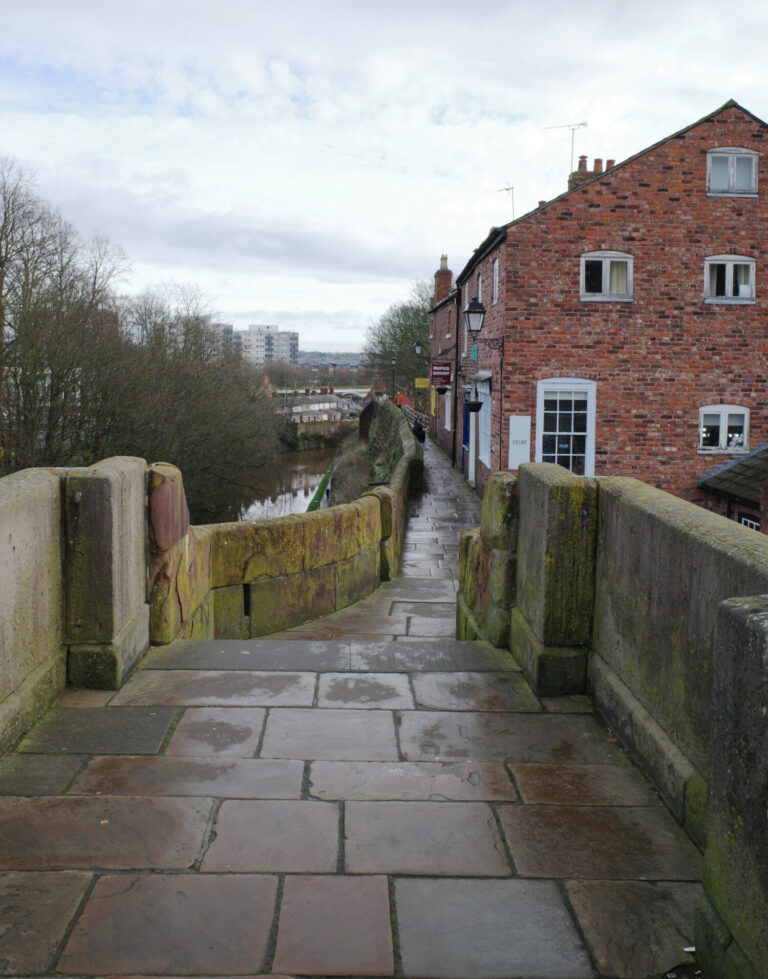 Photo: habiloid (CC BY-SA 2.0) via Wikimedia Commons
Chester City Walls
The walls are the reason Chester looks the way it does. The Romans began them around AD 70–80 as an earth rampart topped with a timber palisade around the new fortress of Deva Victrix, rebuilt them in quarried sandstone from about AD 100, and the Normans pushed the circuit west and south after 1070 to enclose their castle. What you walk today was substantially complete by the middle of the 12th century.
The full loop is about 1.8 miles and takes an hour at an easy pace – the most complete circuit of city walls anywhere in Britain, and free. Going clockwise from the Eastgate you pass the Cathedral, King Charles’ Tower, the Water Tower and Bonewaldesthorne’s Tower out on the old quayside, then the long southern stretch above the Roodee and the Dee. Four gates – Eastgate, Northgate, Watergate and Bridgegate – carry the walkway over the roads beneath. Nearly all of it is Grade I listed and the whole circuit is a scheduled monument. Some sections have steps and a few are narrow, so allow extra time if that matters to you.

The Rows
Chester’s strangest and best feature: a second tier of shops at first-floor level, reached by steps from the pavement, with a continuous covered walkway running in front of them and more shops at street level below. They follow the four streets radiating from Chester Cross – Eastgate, Watergate, Northgate and Upper Bridge Street – and nothing quite like them exists anywhere else in the world.
Nobody is certain how they came about. Timber dating puts the earliest at the 13th century, with the first written mention in 1293. One theory ties them to the great fire of 1278, after which owners may have been required to build fireproof stone undercrofts; another has medieval buildings raised on the accumulated rubble of collapsed Roman structures, with cellars dug out beneath them later. Look for Three Old Arches on Bridge Street, which has the earliest identified stone shopfront in England, and the sandstone undercroft at Cowper House. Much of the black-and-white you see is Victorian mock-Tudor rather than medieval – Chester rebuilt enthusiastically in the 19th century – but the structure underneath is the real thing.
 Photo: Michael D Beckwith (CC0) via Wikimedia Commons
Chester Cathedral
Founded as the Benedictine abbey of St Werburgh in 1093 by Hugh d’Avranches, Earl of Chester, on a site that may have seen Christian worship since Roman times. It escaped the fate of most monasteries at the Dissolution: in 1541 Henry VIII made it the cathedral of a new diocese, and the abbey’s last abbot became the cathedral’s first dean.
The building is a lesson in English medieval architecture – Norman work in the north transept and north-west tower, 13th and 14th-century Gothic through the body of the church, and Perpendicular in the south transept and cloisters. The choir stalls of around 1380 are among the finest in the country, with 48 misericords carved with subjects ranging from the devout to the frankly rude. The monastic buildings survive more completely here than almost anywhere in England: cloisters, chapter house and refectory are all still standing. George Gilbert Scott’s restoration of 1868–76 was heavy-handed enough to help provoke the founding of the Society for the Protection of Ancient Buildings. The detached Addleshaw bell tower of 1975 was the first free-standing cathedral belfry built in England since the Reformation.
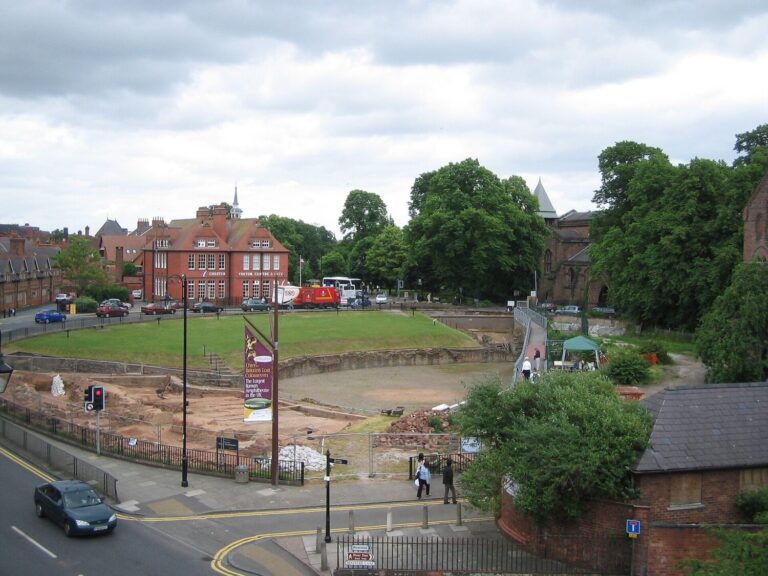 Photo: Nadia (CC BY-SA 2.0) via Wikimedia Commons
The Roman Amphitheatre
The largest known Roman amphitheatre in Britain, and the most substantial Roman structure still visible in the city. It went up in the late 70s AD alongside the new fortress, then was rebuilt on a grander scale around 200 AD, when the seating roughly doubled to something like 8,000 – considerably more than the garrison, which suggests the civilian settlement outside the walls was using it too.
Only the northern half is uncovered; the rest lies beneath Georgian houses and St John’s churchyard, and a painted mural on the far side completes the curve so you can read the shape of the whole. It fell out of use around 350 AD and was built over and forgotten, not rediscovered until the 20th century. Excavation has since turned up a shrine to Nemesis at the north entrance and evidence of both gladiatorial combat and routine military training. It sits just outside the walls by Newgate, two minutes from the Roman Gardens and St John’s, and it is free and open to walk into.

The Eastgate Clock
The most photographed clock in England after Big Ben, or so Chester claims – and on a summer afternoon, watching the queue of people backing into the road to frame it, the claim is hard to argue with. The ornate ironwork was designed by John Douglas, the local architect whose buildings are all over the city, and the movement was made by J. B. Joyce & Co. of Whitchurch in 1897, who then wound and maintained it weekly until 1974.
It was opened on 27 May 1899, Queen Victoria’s eightieth birthday, having been commissioned two years earlier to mark her Diamond Jubilee. It stands on the Eastgate itself, a gateway of 1768 that replaced the medieval gate, which in turn stood on the site of the original entrance to the Roman fortress – a timber tower first, rebuilt in stone around AD 100. Gate and clock together are Grade I listed. The best view is from the wall walk on either side rather than from the street below, and it is worth coming back after dark when it is lit.
Roman and medieval Chester
Chester began as Deva Victrix, fortress of the Twentieth Legion, and a surprising amount of it is still there – some in plain sight, some in places you would walk straight past.
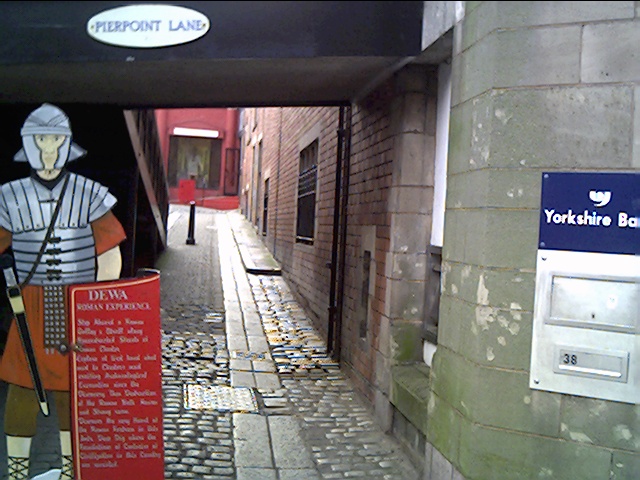 Photo: chestertouristcom (CC BY-SA 2.0) via Wikimedia Commons
Deva Roman Experience
A small museum that does one thing very well: it puts you at street level in Roman Chester. You walk a reconstructed fortress street – granary, barracks, bath-house, taverna and market stalls – with the sounds and smells laid on, before the floor opens up onto the real thing.
Beneath the building are genuine excavated remains, Roman, Saxon and medieval layered one on top of another, seen from a walkway that runs through the middle of the dig. A hands-on gallery at the end lets you try on armour, handle replica pottery and work a catapult, which makes this a reliable hour with children on a wet afternoon. It is tucked down Pierpoint Lane, a narrow alley off Bridge Street that is very easy to walk past – look for the Roman soldier standing outside.
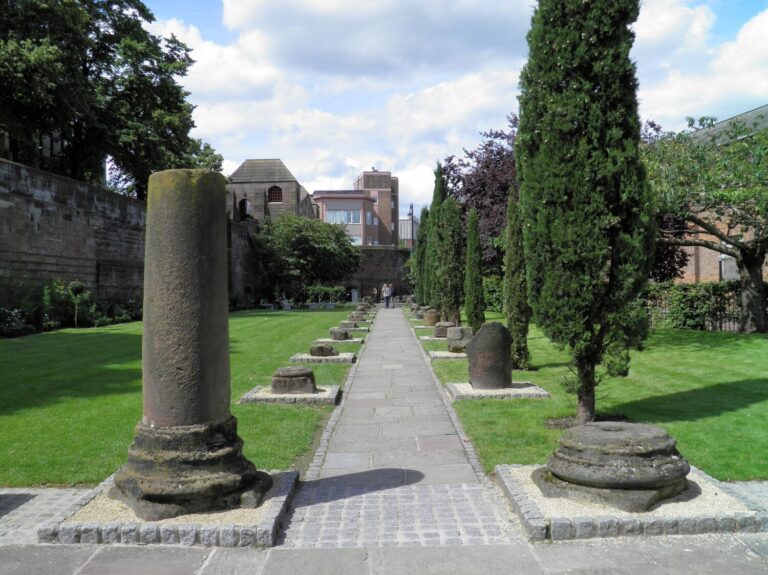 Photo: Carole Raddato (CC BY-SA 2.0) via Wikimedia Commons
The Roman Gardens
Not a Roman garden at all, but a display of Roman Chester assembled in 1949 by Charles Greenwood and the archaeologist Graham Webster, running along the foot of the walls between Newgate and the river.
The columns lining the path came from the fortress bath-house and the legionary headquarters, recovered during 19th-century excavations and re-erected here rather than lost to a store room. There is a reconstructed hypocaust showing how the under-floor heating worked, a reconstructed mosaic from the main baths, and carved fascias from Deva’s most important buildings. The gardens were redesigned in 2000 with interpretation boards and better access down to the riverside. It is free, takes ten minutes, and it connects the amphitheatre to the Groves – so it is easy to fold into a walk rather than make a trip of.
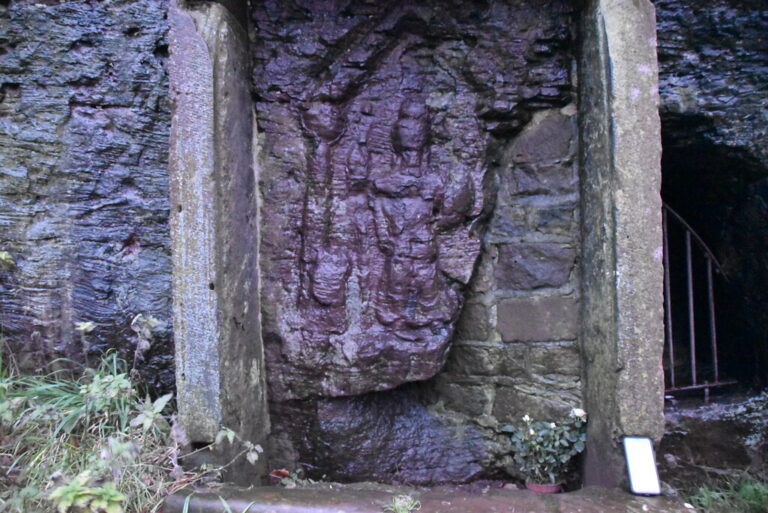 Photo: N Chadwick (CC BY-SA 2.0) via Wikimedia Commons
The Minerva Shrine
Across the Old Dee Bridge in Handbridge, in a scrap of public ground called Edgar’s Field, a weathered figure of Minerva is carved directly into the face of a sandstone quarry. It dates from the early 2nd century, and it is considered the only Roman rock-cut shrine anywhere in western Europe still standing in the place it was carved.
This was the quarry that supplied the stone for the fortress across the river, and the shrine sat beside the main Roman road running south – the goddess of craft and wisdom watching over the men cutting the stone. She is shown in simplified form within a representation of a temple, without the helmet and shield she usually carries. Centuries of weather and deliberate damage have worn the carving badly, and a stone hood has sheltered what survives since the 19th century; a much clearer cast is on display at the Grosvenor Museum. Next to it is Edgar’s Cave, a fissure in the rock face that was probably natural and later enlarged. Free, always open, and almost always empty.
 Photo: Jeff Buck (CC BY-SA 2.0) via Wikimedia Commons
St John the Baptist Church
Chester’s other great church, and for about twenty years its cathedral. Tradition puts a foundation here in 689; what is documented is 1075, when Bishop Peter moved the seat of the Lichfield diocese to Chester and St John’s became a cathedral. The see moved on to Coventry in 1095 and the church settled back into parish life.
The nave and chancel hold the best 11th and 12th-century church architecture in Cheshire – massive Norman piers, still in use for worship every week. Outside, the east end is a roofless ruin: much of it was pulled down after the Dissolution, and what stands is now a scheduled monument in its own right. The towers have had a hard time of it, collapsing in 1468, twice in the 1570s, and again in 1881 during Victorian restoration work. The ruins sit between the amphitheatre and the river, and the small anchorite’s cell nearby was once attached to the church.
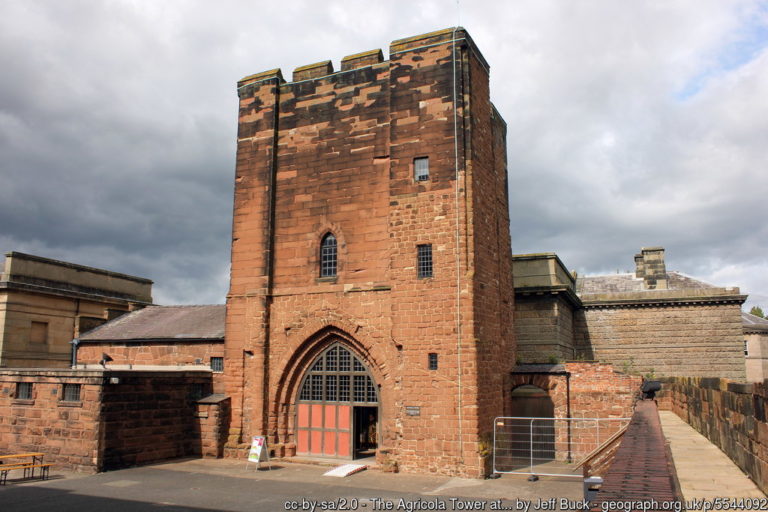
Chester Castle & the Agricola Tower
Hugh d’Avranches, Earl of Chester, threw up a motte-and-bailey here in 1070, probably over an earlier Saxon fortification. What survives of the medieval castle is chiefly the 12th-century Agricola Tower, a stone gateway with the chapel of St Mary de Castro on its first floor. Conservation work in the 1990s uncovered 13th-century wall paintings there showing the Visitation and miracles of the Virgin – a genuinely rare survival, and the chapel now serves as the Cheshire Regiment’s regimental chapel.
The rest of the site is a different building altogether. Between 1788 and 1822 Thomas Harrison rebuilt the outer bailey as courthouse, prison, barracks and armoury in the Greek Revival style, and Pevsner rated the result one of the most powerful monuments of the Greek Revival in the whole of England. The propylaeum – the enormous Doric entrance screen on Grosvenor Street, flanked by lodges like little temples – is the part everyone photographs. The Crown Court still sits in Harrison’s Shire Hall, and the Cheshire Military Museum occupies the former barracks.
Museums and culture
Two of these are free, and the Grosvenor holds one of the most important collections of Roman tombstones in the country.
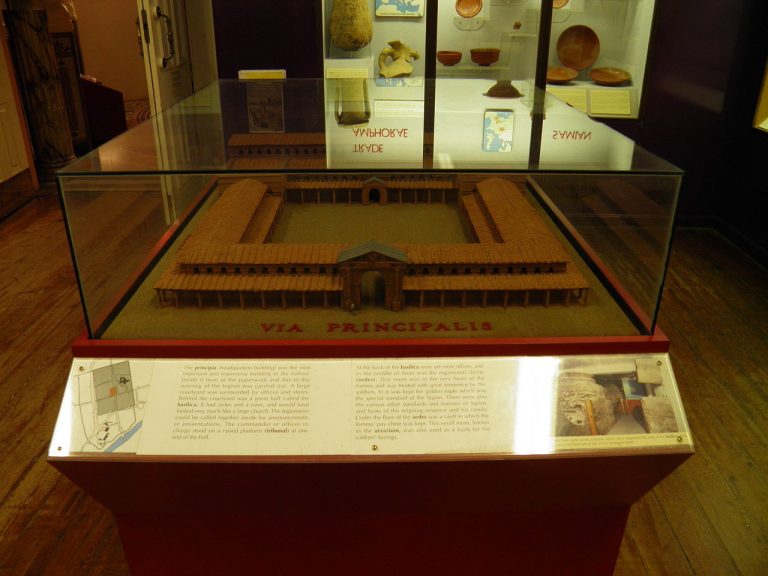
Grosvenor Museum
Chester’s main museum, free to enter, and rather better than a city of this size has any right to expect. It opened in 1886, funded largely by the first Duke of Westminster, who put in £4,000 towards the £11,000 raised and gave the land on Grosvenor Street; Thomas Lockwood designed the building.
The Roman stones gallery is the reason to come. It holds one of the most important collections of Roman tombstones in Britain, most of them recovered from the north wall in the 1880s, where they had been broken up and reused as building rubble – which is precisely why so many survived, and why a few still carry traces of their original paint. Elsewhere there is natural history, a gallery of Chester silver, the largest public collection of Louise Rayner’s paintings of the city, and a set of Bressan recorders. At the back, 20 Castle Street is fitted out as a period house running from a Jacobean parlour through to a Victorian kitchen, begun by the curator Graham Webster in 1955.

Cheshire Military Museum
Housed in Thomas Harrison’s old barracks inside the castle grounds, this covers three centuries of the county’s regiments – the Cheshire Regiment above all, alongside the Cheshire Yeomanry and the Carabiniers.
It is a regimental museum in the traditional mould: uniforms, medals, colours, weapons and the ordinary possessions of the men who carried them, arranged chronologically from the 17th century through both world wars and on to recent service. The strength of it is the personal material – letters, photographs, kit – which does far more to convey what the soldiering was actually like than any case of ordnance. The Agricola Tower chapel next door is the regimental chapel. Best combined with a look round the castle rather than visited on its own.
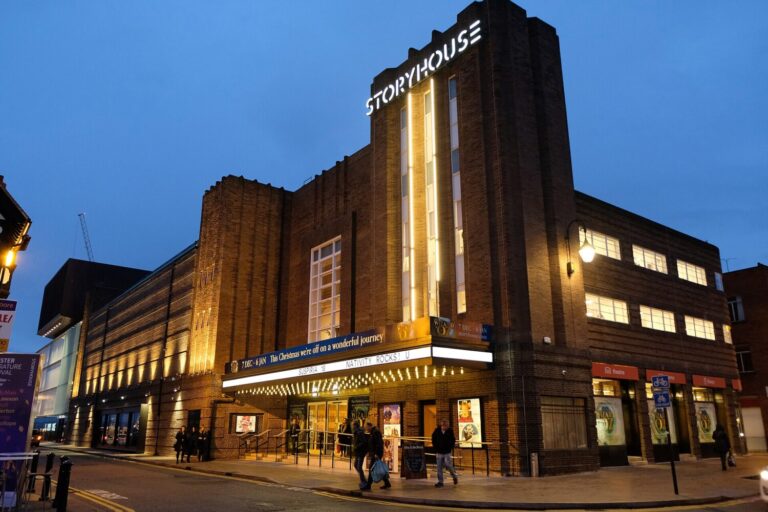 Photo: Jeff Buck (CC BY-SA 2.0) via Wikimedia Commons
Storyhouse
A 1936 Art Deco Odeon that had stood empty since 2007, reopened in May 2017 as theatre, cinema and library in a single building – at the time the largest regional arts project in the country, at a cost of £37 million.
The old cinema shell was kept and a new theatre grafted on behind it. There is a main auditorium that converts between an 800-seat proscenium and a 500-seat thrust stage, a 150-seat studio, and a 100-seat boutique cinema inside the restored Odeon. The library is not shut away in a corner: the shelves run through the whole building, past the bar and the foyer, and it stays open late. Queen Elizabeth II formally opened it in June 2018. Even with nothing booked it is worth walking in – it is the best modern building in Chester, and the ground floor is open to anyone.
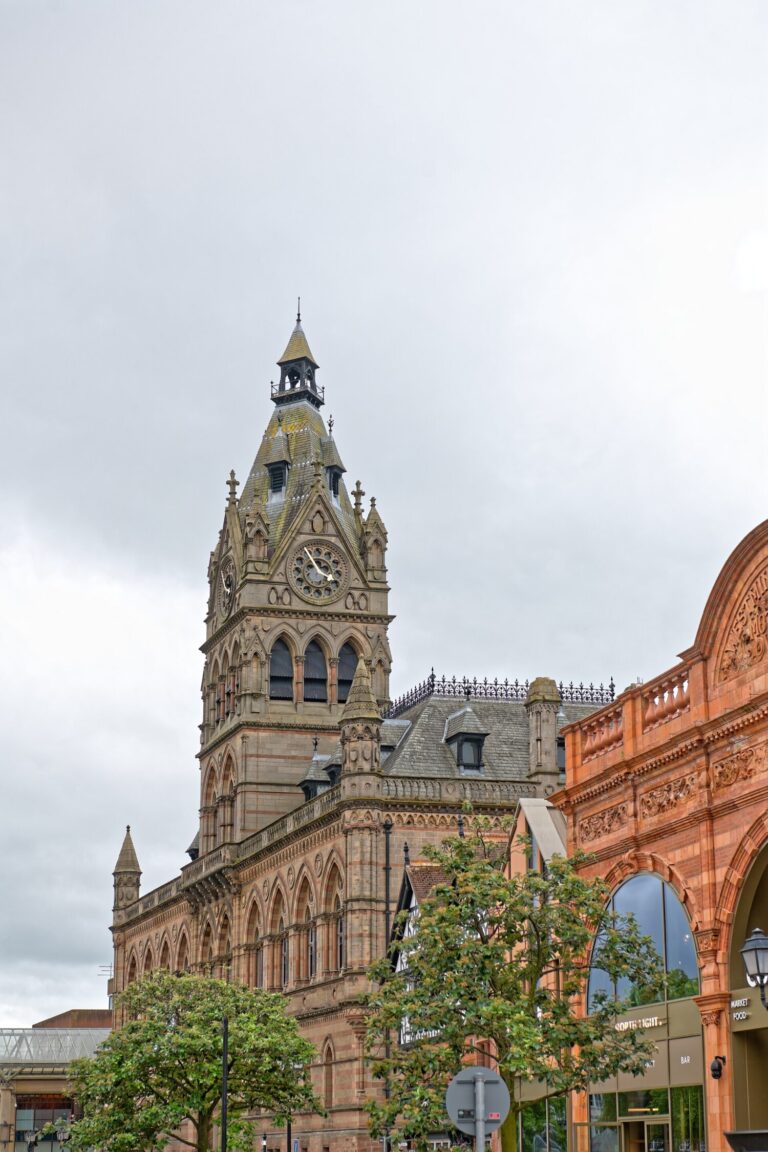 Photo: Tilman2007 (CC BY-SA 4.0) via Wikimedia Commons
Chester Town Hall
Gothic Revival at full volume, built to replace the Exchange of 1698 after it burned down in 1862. William Henry Lynn of Belfast won the competition, and the Prince of Wales – the future Edward VII – opened the building on 15 October 1869 with Gladstone, then Prime Minister, in attendance.
It is faced in banded pink and buff sandstone under a grey-green slate roof, with a spire rising to 160 feet, and it cost £40,000 – something over £4 million in today’s money. Lynn applied late 13th-century Gothic detail to a thoroughly modern civic purpose, and the building squares up to the Cathedral across Northgate Street in a way that reads as entirely deliberate. It is Grade II* listed and still the seat of local government, so the interior is not generally open, but the exterior and the square in front of it make one of the best pieces of Victorian townscape in the north-west.
Riverside, parks and days out
The Dee, the parks and the zoo – where Chester goes when the sun comes out.

Chester Zoo
The most-visited wildlife attraction in Britain, and by most rankings one of the best zoos in the world. George Mottershead founded it in 1931 on a principle that was genuinely radical at the time – enclosures without bars – reportedly after being appalled as a boy by the cages he saw at Belle Vue in Manchester.
It now holds close to 30,000 animals of over 500 species across 130 acres of public grounds, within a wider estate of around 400. Islands, developed between 2015 and 2017 at a cost of £40 million, recreates six South-East Asian habitats and contains Monsoon Forest, the largest indoor zoo habitat in the UK; Heart of Africa followed in 2025 with a 22-acre savannah holding 57 species. The zoo runs as a charity, takes no government funding, and puts a serious conservation and breeding programme behind the public side of the operation. It is at Upton, roughly two miles north of the city centre, and it genuinely does take a full day.
 Photo: Colin Park (CC BY-SA 2.0) via Wikimedia Commons
The Groves & the River Dee
The riverside promenade below the walls, and where Chester goes on a warm afternoon. There is a Victorian bandstand that still gets used, ice cream, benches under the trees, and boats – rowing boats and pedaloes by the hour, and cruisers running trips up the Dee.
At the eastern end the Queen’s Park suspension footbridge crosses to Handbridge on a single span of 275 feet. The present bridge dates from 1923, replacing an earlier crossing of 1852, and it bounces gently underfoot, which children find considerably more interesting than the view. From the Groves you can carry on upriver towards the meadows, or turn back up through the Roman Gardens to the amphitheatre – the whole loop from the Eastgate and back is comfortably under an hour.
 Photo: Łukasz Nurczyński (CC BY-SA 4.0) via Wikimedia Commons
Grosvenor Park
Twenty acres on the slope between the walls and the river, given to the city by Richard Grosvenor, 2nd Marquess of Westminster, laid out by the landscape gardener Edward Kemp in 1865–66 and opened with considerable ceremony in November 1867. John Douglas – the Eastgate Clock architect again – designed the lodge and the gates.
It is one of the best-preserved Victorian parks in the country, raised to Grade II* on the national register of historic parks in 2013 and restored at a cost of £3.6 million the following year. Inside there is a miniature railway, Billy Hobby’s Well under a canopy by Douglas, a marble statue of the Marquess by Thomas Thornycroft, and three medieval arches moved here from elsewhere in the city. The Grosvenor Park Open Air Theatre runs through July and August and has built a real reputation, to the point of being called a northern alternative to Regent’s Park. The old keeper’s lodge is now a café.
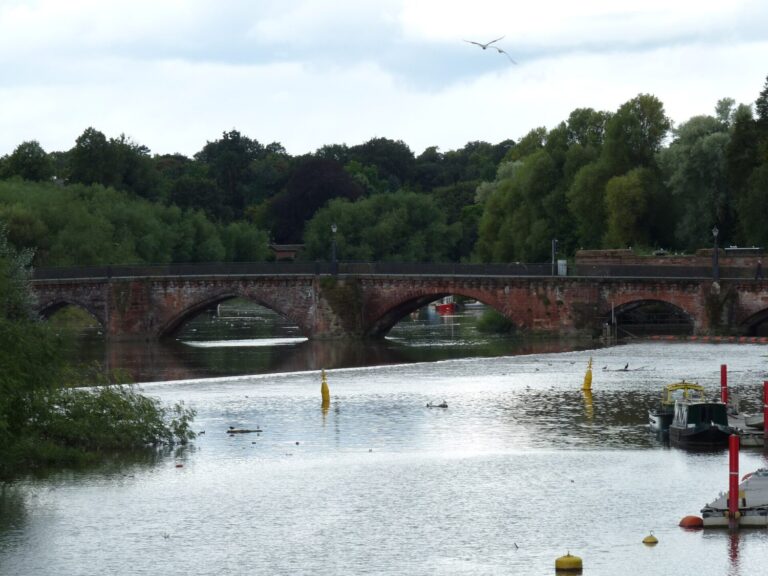 Photo: Chris McKenna (CC BY-SA 3.0) via Wikimedia Commons
The Old Dee Bridge
The city’s oldest crossing, and for centuries its only one. There was a Roman bridge here; it had gone by the 10th century, leaving nothing but a ferry, and a bridge was back in place by the time of Domesday in 1086. What stands today is largely the rebuilding of 1387, in local red sandstone, with seven arches all of different dimensions.
A tower was added between 1399 and 1407, and Thomas Harrison widened the bridge in 1825–26. The southernmost arch replaced a medieval drawbridge. It carried all the traffic into North Wales until the Grosvenor Bridge opened in 1832, and it still carries traffic now, which is a fair testament to 14th-century masonry. It is Grade I listed and a scheduled monument. Cross it on foot from the Bridgegate to reach Handbridge and the Minerva Shrine.

Chester Racecourse
Guinness World Records recognises the Roodee as the oldest racecourse still in operation anywhere in the world, with racing recorded here since 1539. The name is a corruption of “Rood Eye” – the island of the cross – after the small cross that still stands on the raised mound in the middle of the course.
The site was a Roman harbour before the Dee silted up, which is why it is so flat, and it sits in a bend of the river tight against the walls. At just over a mile round it is the smallest course of any significance in England, with a home straight of only 239 yards; the tight turns favour handy, quick horses and regularly catch out big galloping types shipped in from elsewhere. The May Festival and the Chester Cup are the meetings to aim for. Best of all, you can watch from the city walls along the eastern edge for nothing, with a clear view of the entire circuit.
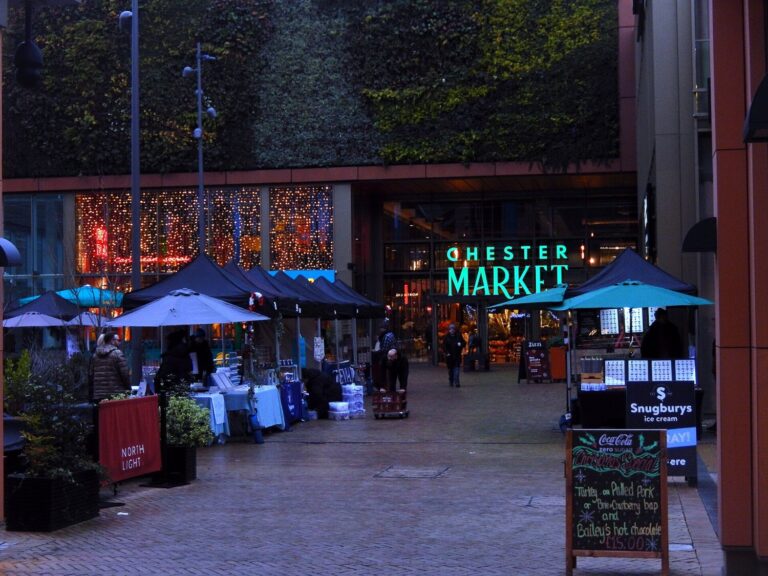 Photo: Stephen McKay (CC BY-SA 2.0) via Wikimedia Commons
Chester Market
The market moved in November 2022 into a purpose-built hall in Exchange Square, behind the Town Hall, after fifty-five years in the concrete Forum building that preceded it. The new one is a deliberate hybrid of traditional market and modern food hall, and about half the old traders made the move.
Around sixty stalls, built from sixty tonnes of solid oak, run from greengrocers and butchers through to independent makers, with a bar in the middle and a good spread of food traders around the edges. There are four distinct seating areas, including a garden under a pergola and booths for people who want to settle in. A heritage corner keeps an 1875 map of the city along with archaeological material turned up during construction, and the Chester in Lego model came over from the old market. It opens six days a week, closed Mondays, and runs late – until 10pm Tuesday to Saturday.
Plan the rest of your trip
Once you have picked your attractions, the rest of the site covers the history behind them, where to eat and drink, where to stay, getting to Chester and day trips into North Wales and beyond.
Photographs are credited beneath each image. Images without a credit are from this site’s own collection. Sourced images are used under Creative Commons licences via Wikimedia Commons.