
Chester history · AD 400–1070
Saxon and Viking Chester
Six centuries between the legions and the Normans, when Chester was a Mercian stronghold, an Irish Sea trading port and, for a while, the busiest mint in England.
Between the last Roman soldier and the first Norman earl lie roughly six hundred years that most visitors walk straight past. They are the centuries in which Chester stopped being a fortress and started being a city — a Mercian burh, a Hiberno-Norse trading town, and for a few decades in the tenth century the most productive mint in England.
Very little of it is visible. There is no Saxon quarter to walk round and no Viking longhouse to look at. But the shape of the modern city was set in this period: the line the walls take, the position of the cathedral, the crossroads at the Cross. The objects that survive are mostly in the Grosvenor Museum, a few minutes from any of it.
The short version
After the legions
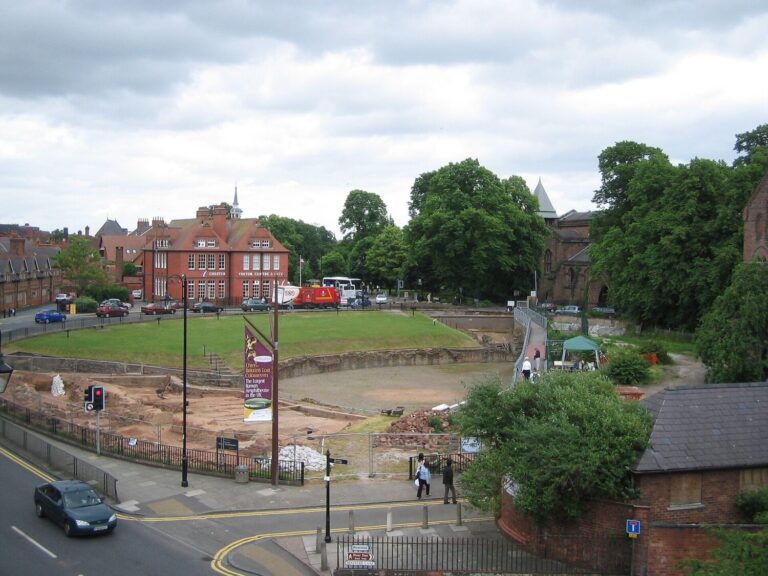 Photo: Nadia (CC BY-SA 2.0) via Wikimedia Commons
The empty fortress, 400–900
The garrison drained away in the late fourth or early fifth century. No Chester-based unit appears in the Notitia Dignitatum of around 395, and nothing replaced it. What happened next is largely guesswork. The fortress walls stood; the timber buildings inside did not. For perhaps two hundred years the site was a walled ruin with people living in it rather than a functioning town.
The one fixed point is 616, when Æthelfrith of Northumbria defeated a Welsh army outside the city at the Battle of Chester. Bede records the killing of monks from the monastery at Bangor-is-y-coed who had come to pray for a British victory — a detail he plainly relished, and one that has coloured the story ever since. After that Chester passes into Mercian hands, and out of the written record for the best part of three centuries.
907 and the burh
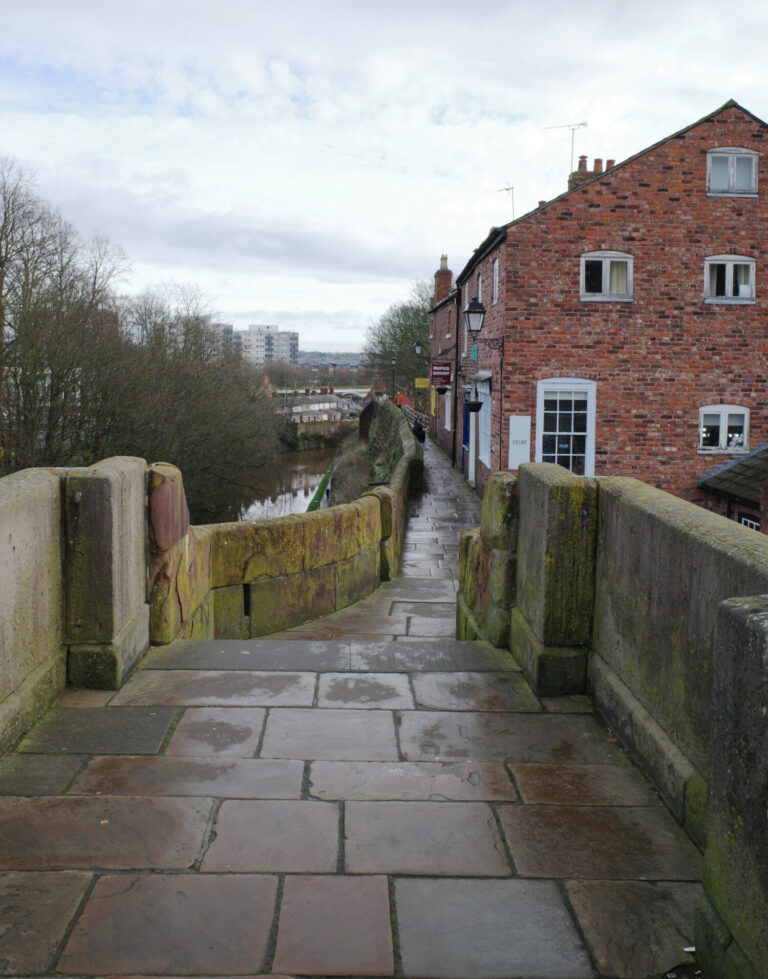 Photo: habiloid (CC BY-SA 2.0) via Wikimedia Commons
Æthelflæd rebuilds the walls
In 902 a Hiberno-Norse community was expelled from Dublin. Their leader, Hingamund, was given land in Wirral, and within a few years was looking hungrily at Chester. Æthelflæd, daughter of Alfred the Great and ruler of Mercia in her own right, raised an army and drove the attack off.
Around 907 she refortified the town as a burh. Where exactly her walls ran is still unknown, but the evidence points to her reusing the Roman defences — the western wall in particular — with the Dee covering the south and west. Applying the Burghal Hidage formula to Cheshire’s assessment of roughly 1,200 hides gives a defended circuit of about 1,524 metres, an L-shaped enclosure rather than the full Roman rectangle. In the same year she dedicated a new church to St Peter. Its successor still stands at the Cross.
The Viking city
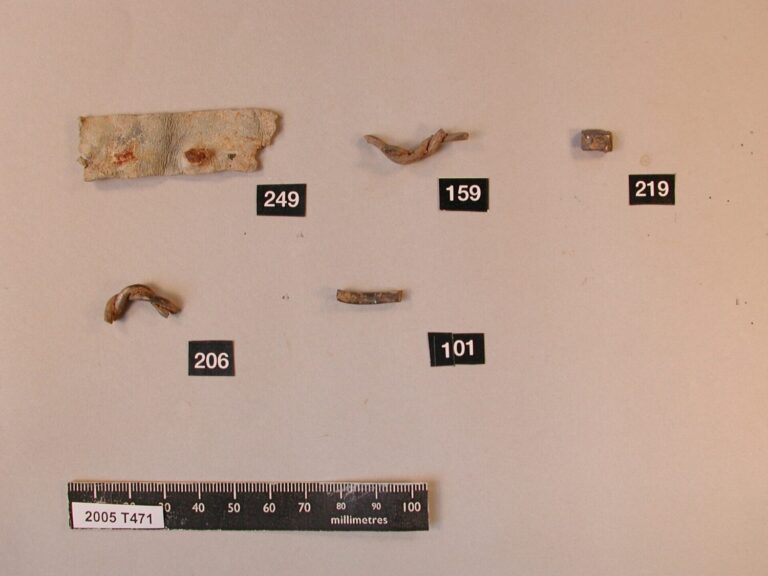 Photo: Lancashire County Council / Dot Boughton (CC BY-SA 2.0), via Wikimedia Commons
Dublin at the other end
Chester’s Norse population was not an occupying force but a trading community, settled south of the old fortress on the slope down to the river. Excavation on Lower Bridge Street turned up bow-sided huts of a kind familiar from Dublin, and brooches decorated in Borre-Jellinge style that are effectively identical to Dublin work. These were the same people, moving between the same two ports.
Across the water in Handbridge, land was assessed in carucates rather than hides — a Scandinavian measure, and a fair indication of who was farming it. The Huxley hoard, ploughed up in Cheshire in 2004, shows how the economy worked: arm-rings deliberately chopped into fragments, silver to be weighed on a balance rather than counted as coin.
The mint that out-produced London
Chester’s most surprising claim to fame is monetary.
Under Æthelstan (924–939) at least twenty-five moneyers worked in the city, around twenty of them striking simultaneously. London had ten. Winchester had seven. This was the high-water mark of Chester as an economic centre, and it is no coincidence that it happened while the Irish Sea trade was at its height.
The mint stayed large under Edmund and Eadred — about seventeen moneyers — and under Edgar, who still had around twenty working by 970. Edgar’s coinage reform of about 973 ended it. Numbers collapsed to five and never recovered, and the Chester mint had closed for good by 1180.
973: eight kings on the Dee
 Photo: Colin Park (CC BY-SA 2.0) via Wikimedia Commons
The most famous afternoon in Saxon Chester
In 973, shortly after his long-delayed coronation at Bath, King Edgar came to Chester and met around eight princes — among them the kings of the Scots and of Strathclyde, the king of Gwynedd and other Welsh rulers, and the king of the Isles. The chroniclers say they rowed him on the Dee while he took the helm.
Later writers turned this into a tableau of submission, and it has been retold that way for a thousand years. Modern historians read it more cautiously: an ad hoc pact to keep the peace across the Irish Sea, made between rulers who needed each other. Either way it tells you what Chester was for. This was where England’s power met the sea lanes to Ireland, Man and the north.
St Werburgh comes to Chester
 Photo: Michael D Beckwith (CC0) via Wikimedia Commons
A saint moved out of danger
Some time in the ninth century the body of St Werburgh — a Mercian princess and abbess, and a niece of King Æthelred — was brought from Hanbury in Staffordshire to Chester, out of reach of Viking raiders, and reburied in the church of SS Peter and Paul. Relics were not sentimental objects. A saint drew pilgrims, and pilgrims brought money and status.
The church became the minster of St Werburgh, and in 1092 Anselm, then abbot of Bec, came at Earl Hugh’s invitation and refounded it as a Benedictine abbey. That foundation is the building we now call Chester Cathedral. Werburgh’s shrine, smashed at the Reformation and reassembled in the nineteenth century, still stands in the Lady Chapel.
1070: the Normans arrive
Chester held out longer than almost anywhere. William reached it in the winter of 1069–70, at the end of the harrying of the north, and the cost is written into Domesday Book. Of 487 houses standing in 1066, 205 had gone by 1086, most of them cleared for the castle. The surveyors recorded the city as greatly wasted, and its farm — the annual render to the crown — had fallen by a third, from £45 to £30.
Hugh d’Avranches received the city and the new earldom around 1071. He built the castle, refounded the abbey, and pushed the farm back up to roughly £70 and a mark of gold. Chester also paid in kind: three timber of marten pelts, a hundred and twenty skins a year, a reminder of how much of its wealth still came across the water.
Where to see it today
Honestly: not much of it survives above ground, which is exactly why it repays a bit of reading first. The Grosvenor Museum holds the Anglo-Saxon and Viking material, including coins from the mint. The cathedral holds Werburgh’s shrine. And the western stretch of the city walls, between the Watergate and the Water Tower, is the section most likely to follow the line Æthelflæd chose.
Keep reading
Chester history in order, from the fortress to the present day.
Roman Chester · Medieval Chester · Georgian and Victorian Chester · All history
Photographs are reproduced under Creative Commons licences; the photographer and licence are credited beneath each image.
Hero photograph: Jeff Buck (CC BY-SA 2.0), via Wikimedia Commons