
Chester history · AD 689 to now
St John the Baptist
Chester’s first cathedral, and the most under-visited great building in the city — a Norman nave of astonishing scale, standing next to its own ruins.
Everyone goes to the cathedral. Almost nobody walks the extra five minutes outside the walls to St John’s, which is a mistake, because the interior is the finest piece of Norman architecture in Cheshire and the ruins outside are the most atmospheric corner of Chester.
It was also, for twenty years, the cathedral of the diocese. The building has spent the nine centuries since slowly falling down and being put back up.
The short version
Older than the abbey
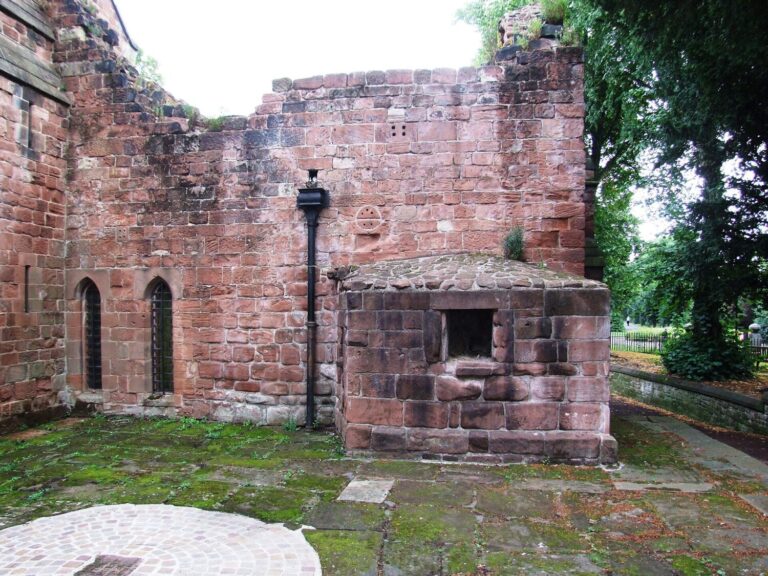 Photo: RLamb (CC BY-SA 3.0), via Wikimedia Commons
689 and 973
Tradition credits the foundation to King Æthelred of Mercia in AD 689, and while that date cannot be proved, a minster church here in the late seventh or eighth century is entirely plausible. It stood outside the old Roman walls on the river cliff, which is where Anglo-Saxon minsters often went — beside the water, on the approach to the town rather than inside it.
St John’s appears again in 973, when King Edgar is said to have held a royal council here after being rowed on the Dee by his tributary kings. Whatever really happened that day, the choice of church tells you which building mattered most in tenth-century Chester. It was not St Werburgh’s.
Twenty years as a cathedral
The Normans moved their bishops into towns, and Chester got one.
In 1075 Bishop Peter moved the see of Lichfield to Chester and made St John’s his cathedral. His successor moved it again, to Coventry, in 1095. Those two decades are the reason the building is the size it is: the enormous cylindrical piers and round arches of the nave were begun as cathedral architecture, on a scale nothing else in Cheshire attempts.
After the see moved, St John’s became a collegiate church served by secular canons, and building continued on a large scale until the end of the thirteenth century. Walk in and look up the nave: two storeys of massive Norman work, a Transitional triforium above it, and a fourteenth-century clerestory on top. You can read the whole sequence from one spot.
Three collapses
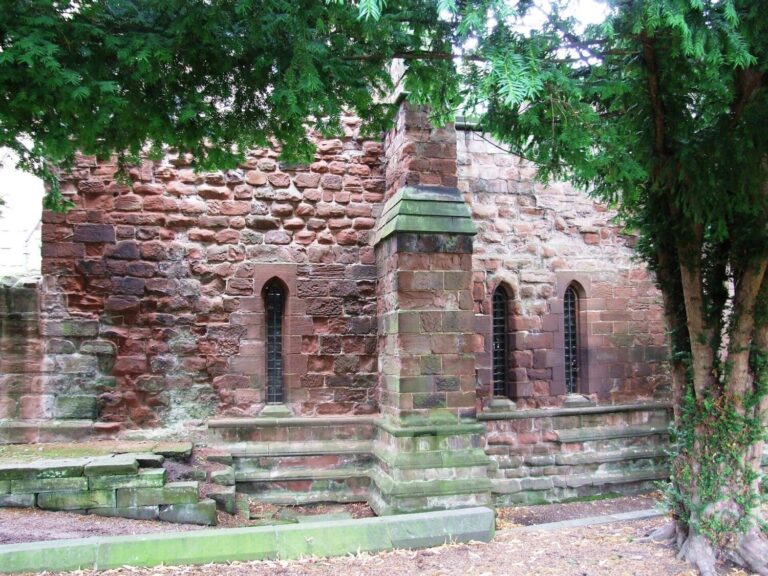 Photo: RLamb (CC BY-SA 3.0), via Wikimedia Commons
1468, 1572–74, 1881
The central tower came down in 1468. The north-west tower partly collapsed in 1572 and then failed more seriously in 1574, taking the western bays of the nave with it — they were rebuilt, as the records put it, on a magnificent scale. After the dissolution of the college much of the east end was simply demolished, and what was left of it became the ruins that now stand in the churchyard.
Then, in 1881, the north-west tower fell again. John Douglas rebuilt the north porch in 1881–82 and added the north-east belfry tower in 1886, and R. C. Hussey had already carried out restorations in 1859–66 and returned in 1886–87. The building you visit is Norman in bone, medieval in most of its fabric, and Victorian wherever gravity has had its way.
The Civil War
St John’s had a bad war. During the siege of 1645 the parliamentary besiegers garrisoned the church, used its tower as an observation post to direct artillery, and put a battery in the churchyard. It stands on high ground immediately outside the eastern walls, which made it the obvious place from which to shell the city — and made it a target in return.
Parish registers survive from 1559, and Elizabeth I granted money towards repairs in 1581, which gives some sense of how long the fabric had been a problem before the guns arrived.
The ruins and the anchorite
The ruined arches at the east end are a scheduled monument and the best-loved corner of the site — a fragment of the great collegiate choir, roofless, with grass and ivy and a view down to the river. Look for the coffin set into the wall with the inscription Dust to Dust; it has been there long enough to have collected several competing legends and no reliable explanation.
Just to the south-east, on the edge of Grosvenor Park, stands the Anchorite’s Cell, a small sandstone building traditionally associated with the church and said to have sheltered a hermit. The story that Harold Godwinson survived Hastings and ended his days in it is medieval, romantic and almost certainly untrue, which has never stopped anyone repeating it.
Visiting
St John’s is on Vicar’s Lane, immediately outside the walls near the Newgate and the Roman amphitheatre — two minutes from the Eastgate. It is a working Church of England parish church, Grade I listed, and normally open to visitors during the day with no charge.
Go inside. Photographs do not convey the scale of the nave, and after the elaborate Victorian surfaces of the cathedral, the plain Norman drums here are a genuine shock. Then walk out into the churchyard for the ruins, and carry on into Grosvenor Park, which starts on the other side of the wall.
Keep reading
More Chester history.
Saxon and Viking Chester · Medieval Chester · Chester Cathedral · All history
Photographs are reproduced under Creative Commons licences; the photographer and licence are credited beneath each image.
Hero photograph: Jeff Buck (CC BY-SA 2.0) via Wikimedia Commons