
1646 – 1901
Georgian & Victorian Chester
The port dies, the walls become a promenade, and a city with no industry rebuilds itself in black and white.
Chester came out of the Civil War poor, damaged and losing its river. What happened next is the most consequential thing in the city’s history, and it happened by omission: the Industrial Revolution went somewhere else.
Manchester and Liverpool took the mills, the docks and the money. Chester, with a silted river and no coal, got none of it – and so had no reason to demolish anything. Instead it became a comfortable county town, a legal and social centre, and a place where the new industrial fortunes came to shop and to live. The Georgians rebuilt its public buildings with real ambition; the Victorians restored, and substantially invented, the half-timbered city that visitors photograph today.
Key dates
Rebuilding the city
Three transformations between the Civil War and the end of Victoria’s reign.
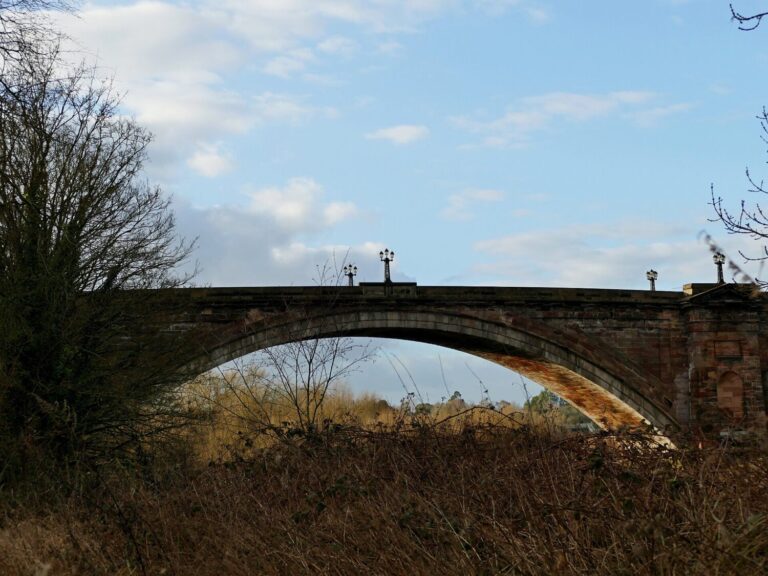 Photo: Wildlife Terry (CC0) via Wikimedia Commons
Thomas Harrison’s Chester
If one person shaped Georgian Chester it was Thomas Harrison, an architect of real national standing who spent much of his career here. Between 1788 and 1822 he demolished most of the medieval outer bailey of the castle and replaced it with a courthouse, prison, barracks and armoury in a severe Greek Revival style. Pevsner called the result one of the most powerful monuments of the Greek Revival in the whole of England, and the propylaeum on Grosvenor Street – a vast Doric screen flanked by temple-like lodges – is still the most striking single piece of architecture in the city.
His other great work is the Grosvenor Bridge. The Old Dee Bridge, largely 14th-century, had become hopelessly inadequate for traffic heading into North Wales. Harrison designed a single stone arch of 200 feet; the first stone was laid in 1827 and the young Princess Victoria opened it in 1832, three years after Harrison’s death. It was the longest single-span stone arch bridge in the world, and held that record for thirty years.

The railway arrives
The station opened on 1 August 1848, and Chester’s position as the junction between England, North Wales and the Irish packet boats at Holyhead made it briefly one of the most important railway towns in the country. Francis Thompson designed it in an Italianate manner with an ornamental frontage running some 1,050 feet – a length that says a great deal about the ambitions of the moment. It is Grade II* listed.
The railway also gave Chester one of the era’s notorious engineering disasters. In May 1847 the Dee railway bridge collapsed under a passing train, killing five people. The bridge was a cast-iron girder design by Robert Stephenson, and the inquiry that followed helped end the use of cast iron in railway bridges – a significant moment in Victorian engineering, and a badly damaging one for Stephenson’s reputation.

Black and white Chester
Here is the thing most visitors do not realise: a great deal of Chester’s famous half-timbering is Victorian. The city had genuine medieval buildings, but from the 1850s onwards a wave of architects – John Douglas above all, along with Thomas Lockwood and others – rebuilt and re-fronted large stretches of the centre in an elaborate black-and-white revival style, some of it careful restoration and a good deal of it confident invention.
The results are not fakery so much as a Victorian argument about what Chester ought to look like, executed with enormous skill and paid for largely by the Grosvenor estate. Douglas designed the Eastgate Clock, raised in 1899 to mark Victoria’s Diamond Jubilee and now said to be the most photographed clock in England after Big Ben. The same period gave the city its Town Hall (William Henry Lynn, opened 1869 by the future Edward VII), the Grosvenor Museum (1886), Grosvenor Park (opened 1867), and the restoration of the Cathedral by George Gilbert Scott – heavy-handed enough to help provoke the founding of the Society for the Protection of Ancient Buildings.
The walls become a promenade
The single decision that did most to preserve the city.
By the 18th century the walls had no defensive purpose left. In most English cities that meant demolition – walls were an obstruction to traffic and a source of free building stone, and the great majority came down. Chester instead repaired its circuit and laid it out as a raised walkway for pleasure, with the gates rebuilt as elegant arches carrying the promenade over the roads beneath. The Eastgate of 1768 is the clearest example.
It was done as civic improvement rather than conservation, but the effect was the same: Chester kept the most complete circuit of city walls in Britain because it found a use for them. Everything else follows from that. The walls are why the medieval street plan survived, why the Roman line is still legible, and why the city has the shape it does.
The industry Chester did not get
One reason Georgian and Victorian Chester looks the way it does — a county town of assembly rooms, banks and villas rather than mills and furnaces — is that the heavy industry of the region happened a few miles the other side of the border, and Chester took the profit without the smoke. The coalfield, the ironworks and the lead all sat in Denbighshire and Flintshire.
The clearest example is Bersham Ironworks outside Wrexham, where John Wilkinson perfected the cylinder-boring machine that made Boulton and Watt’s steam engines possible: without the precision achieved at Bersham, the engines that powered the mills of Lancashire would not have held their steam. Twelve miles away, Chester banked, insured and shipped for that world, and built Harrison’s Greek Revival public buildings out of the proceeds.
It is the same pattern as the medieval castles and the silting port — the money and the administration on the English bank, the digging and the smelting on the Welsh one. Chester’s elegance is partly a function of where the dirty work was done.
Continue
Back to Medieval Chester, Roman Chester or the history overview. To see the Georgian and Victorian city, the attractions page covers the Eastgate Clock, the Town Hall, Grosvenor Park, the Old Dee Bridge and the Grosvenor Museum.
Photographs credited beneath each image where sourced externally. Sourced images used under Creative Commons licences via Wikimedia Commons.