
Chester history · the thing nowhere else has
The Chester Rows
Two tiers of shops on four medieval streets, with a covered walkway running at first-floor level. There is nothing else quite like them anywhere in the world, and nobody is entirely sure why they exist.
Walk into Chester along Eastgate Street and you will notice that the shops are stacked. There is a row at pavement level, and above it a second row set back behind a continuous covered gallery, reached by steps at intervals, with a balustrade looking down on the street. Turn any corner at the Cross and it carries on.
This is the single most distinctive thing about the city. It is medieval in origin, it is unique, and despite two centuries of argument the reason it happened here and nowhere else has never been settled.
The short version
Where they run
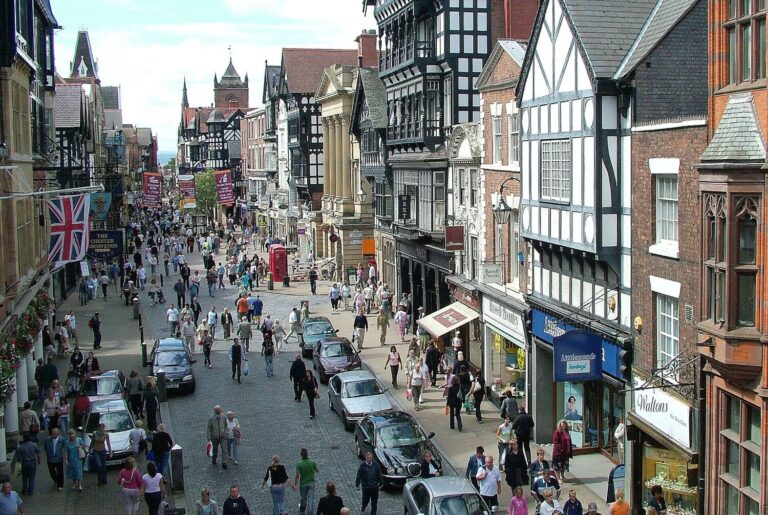 Photo: Mike McBey (CC BY 2.0), via Wikimedia Commons
Four streets from the Cross
The Rows follow the four Roman streets that radiate from Chester Cross. They are continuous on both sides of Upper Bridge Street, run along most of Watergate Street and Eastgate Street, and survive for only a short stretch on the east side of Northgate Street.
There were Rows in Lower Bridge Street too. They were gradually enclosed by the owners during the seventeenth and eighteenth centuries — a private gallery being worth more than a public right of way — and that part of the system is gone. Walking down Lower Bridge Street from the Cross, you can watch the Rows stop.
How old are they?
Older than the buildings you see, and younger than people usually assume.
The earliest possible documentary reference is from 1293, though it is not certain that it means what we mean. The first unambiguous use of the word Row for a raised walkway comes in 1356. Tree-ring dating of surviving timbers takes the fabric back into the thirteenth century, and the consensus is that the system is unlikely to predate about 1200.
Around twenty stone undercrofts of the thirteenth or early fourteenth century survive beneath the Rows — vaulted cellars at street level, several of them still in use as shops and bars. By about 1350 the arrangement had reached its full extent. What you walk along today is overwhelmingly Georgian, Victorian and later in its fabric; the plan underneath it is medieval.
Why? Nobody knows
 Photo: Christopher Hilton (CC BY-SA 2.0) via Wikimedia Commons
Four theories, none of them conclusive
The fire. In 1278 a fire destroyed almost the entire walled town. One argument is that owners were then required to build fireproof ground floors, producing the stone-lined undercrofts, and that a stone undercroft naturally pushes the living accommodation up a level and the shop entrance with it.
The Roman rubble. Chester was built on the ruins of a legionary fortress, and the debris did not lie evenly — it heaped up alongside the streets. Medieval buildings put up on those heaps stood above street level from the start. As properties were improved in the thirteenth century, cellars were dug beneath them, upper storeys were pushed out over the lower ones, and the covered walkway is what was left in between.
Trade, and accident. A third view is simply that undercrofts were valuable, that two levels of frontage let you sell twice as much, and that once a few neighbours had built galleries it was in everyone’s interest to join them up. The Rows may be less a plan than a habit that hardened. All three explanations have respectable support, and they are not mutually exclusive.
What to look for
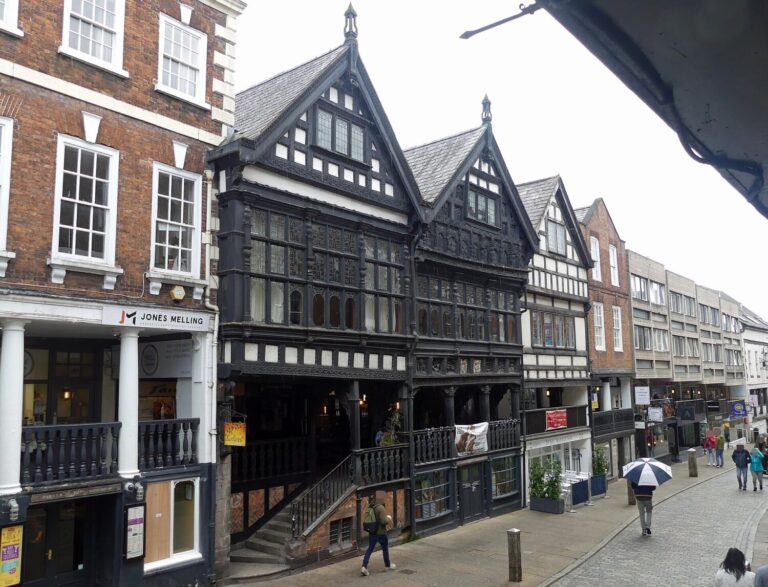 Photo: Dave.Dunford (CC BY-SA 4.0), via Wikimedia Commons
Six buildings worth stopping at
Three Old Arches, 48 Bridge Street, has what is probably the earliest identified stone shopfront in England — three arches of the thirteenth century, sitting in plain sight above a modern shop. Bishop Lloyd’s House on Watergate Street carries the finest carved timber front in the city and is now home to the Chester Civic Trust; the Row runs straight through it and you can go in.
Leche House and God’s Providence House, both on Watergate Street, are the other two most-photographed frontages. The Falcon on Lower Bridge Street was bought by Sir Richard Grosvenor in 1602 and rebuilt in the seventeenth century; in 1643 the family enclosed their stretch of the Row to gain space inside, and it is one of the clearest surviving examples of how the Lower Bridge Street Rows were lost. Tudor House had its Row enclosed by Roger Ormes in 1728.
Also look down. Several of the medieval undercrofts are open as shops and bars — Cowper House at 12 Bridge Street, 11 Watergate Street, and the Crypt Chambers at 28 Eastgate Street among them.
Lost, kept and invented
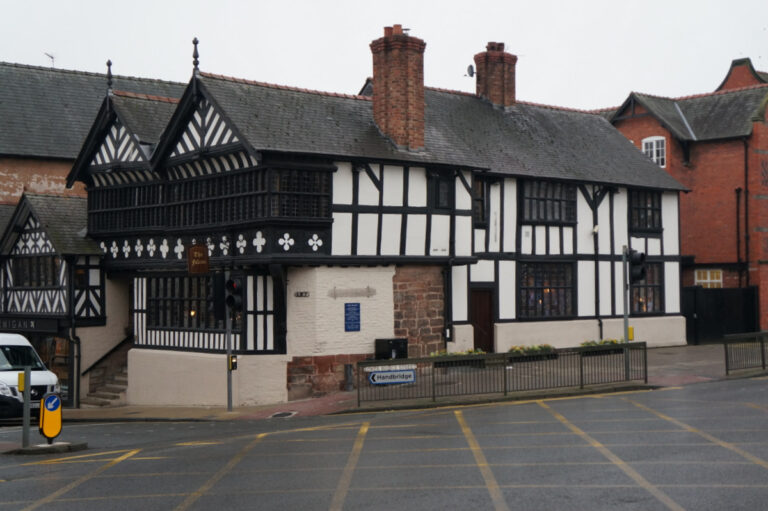 Photo: Ian S (CC BY-SA 2.0) via Wikimedia Commons
The nineteenth century decides
The Georgians were the Rows’ worst enemies: a raised walkway across your frontage is an inconvenience if you are building a bank or a coffee house. Thomas Harrison’s Commercial Coffee Room of 1808 substituted an arcade rather than continuing the Row, and the Chester Bank of 1859–60 simply obliterated its section.
Then the mood changed. T. M. Penson’s Crypt Chambers of 1858 carried the Row on in Gothic Revival dress, and by the later nineteenth century architects such as John Douglas and Thomas Lockwood were rebuilding whole frontages in black-and-white with the Row treated as a point of civic pride. A great deal of what visitors take for Tudor is that work. It is very good of its kind, and it is the reason the system is still continuous.
The Rows today
At least 95 buildings containing sections of Row are listed — nine at Grade I, twenty at Grade II*, sixty-six at Grade II. They are still working shops, which is the point: this is not a preserved street but a shopping centre that happens to be seven hundred years old.
Practically, the Rows have consequences. Access is by steps, and while some sections have level entry from side streets, a full circuit of the upper level is not step-free. Shops on the Row level are quieter and often more interesting than the chains at street level, and in bad weather you can cross most of the city centre without getting wet — which may, in the end, be the real reason somebody thought of it.
Keep reading
More Chester history.
Medieval Chester · Tudor and Stuart Chester · The city walls · All history
Photographs are reproduced under Creative Commons licences; the photographer and licence are credited beneath each image.
Hero photograph: Christopher Hilton (CC BY-SA 2.0), via Wikimedia Commons