
Planning your journey
Getting to Chester
Forty minutes from Liverpool, two hours from London, and easier to reach without a car than most cities its size.
Chester is unusually well connected for a city of 80,000 people, largely because of where it sits: on the border between England and Wales, at the point where the routes into North Wales, the Wirral and the north-west all converge. That was why the Romans built here, and it is still true.
The single most useful thing to know is that you do not need a car. The station is a twenty-minute walk from the Cross, the walled centre is small and largely pedestrianised, and driving into the middle is more trouble than it is worth. If you are coming by car, plan to park on the edge and walk or ride in.
How to get here
Three ways in, in rough order of how much we would recommend them.
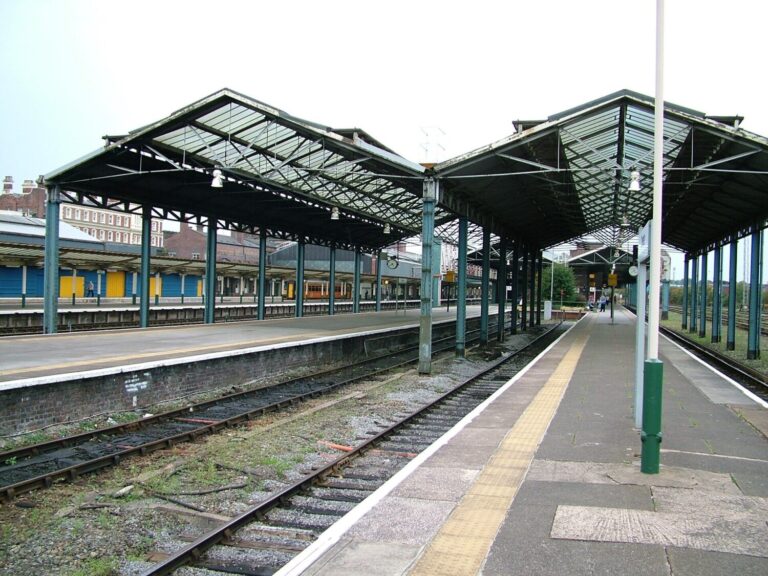 Photo: Tagishsimon (CC BY-SA 3.0) via Wikimedia Commons
By train
Chester station has seven platforms and four operators, which is a lot for a city this size. Transport for Wales manages it; Avanti West Coast, Northern and Merseyrail also run services.
The useful journeys: Liverpool in around 40 minutes on frequent Merseyrail electric services via Birkenhead, which is quicker than driving; London Euston direct in a little over two hours; Manchester in about an hour; Crewe in twenty minutes for connections to almost anywhere. Westward, the North Wales coast line runs to Llandudno Junction, Bangor and Holyhead for the Irish ferries, and south there are trains to Wrexham and Shrewsbury.
The station is on Station Road in Newtown, about three quarters of a mile north-east of the walls. It is a fifteen to twenty minute walk into the centre, mostly downhill on the way in; the canal towpath is a quieter route than the main road. There are taxis on the forecourt and buses from outside. If you are arriving late or leaving early, City Road and Hoole nearby have plenty of places to stay.
 Photo: Quackdave (CC0) via Wikimedia Commons
By car, and where to park
Chester sits just off the M53, which runs up the Wirral to the M56 and on to Manchester, and the A55 expressway heads west along the North Wales coast. From the south the A41 and A483 come up from Shrewsbury and Wrexham.
Parking inside the walls is genuinely difficult and expensive, and much of the centre is pedestrianised. The sensible answer is Park and Ride. Three sites currently operate, each with its own bus straight into the city and back: Wrexham Road (1,200 spaces), Boughton Heath (750 spaces) and Upton by the zoo (460 spaces). Buses run every 15 to 20 minutes on weekdays. The Sealand Road site is suspended.
If you do drive in, the multi-storeys at the Grosvenor Centre and around Pepper Street are the closest to the middle, but a few days of city-centre parking adds up quickly – worth checking whether your hotel has spaces before you book.
 Photo: Stephen Halpin (CC BY-SA 2.0) via Wikimedia Commons
By air and by coach
Two airports are within easy reach. Liverpool John Lennon is about 45 minutes by road and the closer of the two, good for domestic and European budget routes. Manchester is roughly an hour by road and much the larger, with long-haul and a direct rail station of its own – you can train from Manchester Airport to Chester with one change.
Both are straightforward by public transport. From Manchester Airport the train takes around an hour and a quarter. From Liverpool John Lennon, take the bus into Liverpool South Parkway and pick up the train from there.
National Express and other coach operators serve Chester from major cities, arriving at the bus interchange in the centre. It is the cheapest way in and the slowest.
Getting around once you are here
The short answer is: walk.
On foot
The walled centre is barely half a mile across. Everything in it – the Cathedral, the Rows, the amphitheatre, the river – is within fifteen minutes of everything else, and the walls themselves make a raised walkway right round the outside.
Buses
Local services run from the bus interchange near the market and reach the zoo, Hoole, Handbridge and the outer suburbs. The Park and Ride buses are the most frequent thing on the road.
By bike
Chester is flat and has a good network of traffic-free routes, including the Millennium Greenway along a former railway line and the canal towpath. Bike hire is available in the city.
Accessibility
The walls have steps and narrow sections in places, though there are level access points. The centre is mostly flat; the Rows are reached by steps, which is worth knowing in advance.
Onward into North Wales
Worth knowing if you are planning more than Chester: this is the junction for the whole North Wales coast, and that changes what a few days here can cover. The main line from London Euston to Holyhead runs through Chester, so the coast is a through train rather than a change — Llandudno Junction is about an hour west, with Rhyl, Colwyn Bay and Bangor on the same line and Holyhead at the end of it for the Irish ferries. It is the same route the Chester and Holyhead Railway opened in 1848, and the reason the coast became a string of resorts in the first place.
At Llandudno Junction two branches leave the main line. One runs the short hop into Llandudno, the Victorian resort under the Great Orme, which is an easy day return from Chester with time to spare. The other is the Conwy Valley line, which climbs thirty miles inland through Betws-y-Coed to Blaenau Ffestiniog — slow at over an hour end to end because of the gradients and the curves, and one of the better scenic branch lines in Britain. Both are run by Transport for Wales. Conwy itself is a request stop on the coast line, or a short bus ride from the Junction.
Once you arrive
See the twenty attractions worth your time, where to stay, where to eat and drink, the history of the city and day trips into North Wales and beyond.
Journey times are typical rather than guaranteed – check current timetables and Park and Ride fares before travelling. Photographs credited beneath each image; sourced images used under Creative Commons licences via Wikimedia Commons.
Hero photograph: via Wikimedia Commons (CC BY-SA 3.0)