
Where to stay in Chester
Accommodation
Where to base yourself, what each part of the city is like to stay in, and when you need to book a long way ahead.
Chester is a small city that takes accommodation seriously, largely because it has been receiving visitors for about two thousand years. You can stay inside a medieval wall circuit, on the riverbank, in a Victorian terrace or in a thousand acres of Cheshire parkland, and all of those are within half an hour of the Cross.
The decision that matters most is which part of the city you pick, because it changes the cost, the noise and whether you need a car. This page runs through the areas one at a time, then the types of place you will find, then the practical business of when to book.
Where to stay
Five parts of the city, from the walled centre out into Cheshire. Each has a different balance of price, quiet and convenience.
 Photo: Christopher Hilton (CC BY-SA 2.0) via Wikimedia Commons
Inside the walls
If it is your first visit, stay inside the walls. The walled centre is barely half a mile across, which means the Cathedral, the Rows, the amphitheatre, the racecourse and the river are all within ten or fifteen minutes on foot, and you can leave the car parked for the duration. It also means you can walk back from dinner rather than working out taxis.
This is where the grand hotels are – the Grosvenor on Eastgate Street chief among them – along with a cluster of smaller townhouse hotels and serviced apartments converted out of Georgian and Victorian buildings. Prices are the highest in the city and rise sharply on race days and through the Christmas market. Two practical warnings: the centre is lively on Friday and Saturday nights, so ask for a room at the back if you are a light sleeper, and parking is genuinely difficult – check whether your hotel has its own spaces or a permit arrangement before you book, because the multi-storeys add up over a few nights.
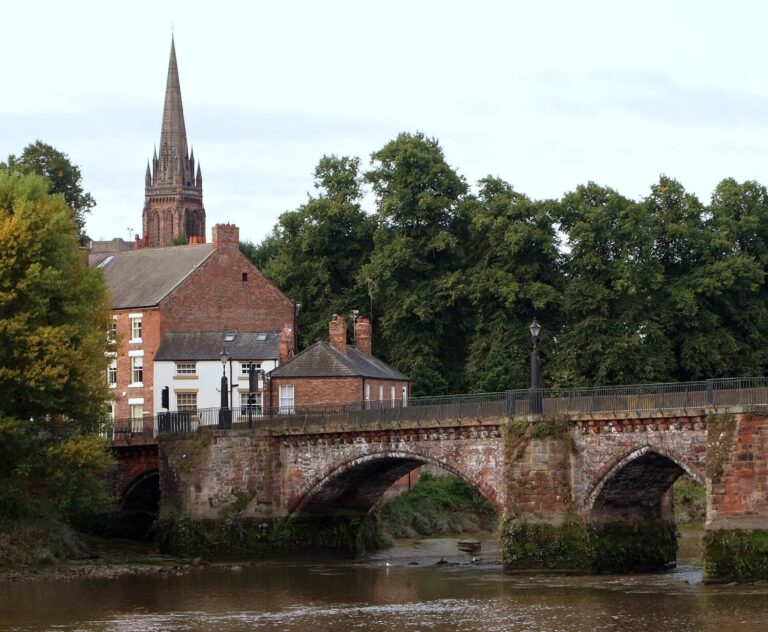 Photo: David Hallam-Jones (CC BY-SA 2.0) via Wikimedia Commons
The riverside and Handbridge
Along the southern edge of the walls the city runs down to the Dee, and a handful of places sit right on the water or on the wall itself. It is a quieter proposition than the centre without being any further from it – the Groves, the Roman Gardens and the amphitheatre are a few minutes’ walk, and you can be at the Cross in ten.
Cross the Old Dee Bridge and you are in Handbridge, an old village swallowed by the city, with the Minerva Shrine at Edgar’s Field and a good pub or two. Rooms here tend to be smaller guest houses and holiday lets rather than hotels, and they are usually better value than the equivalent inside the walls while still being walkable. The trade-off is the hill back up to the Bridgegate at the end of the evening, which is steeper than it looks on a map.
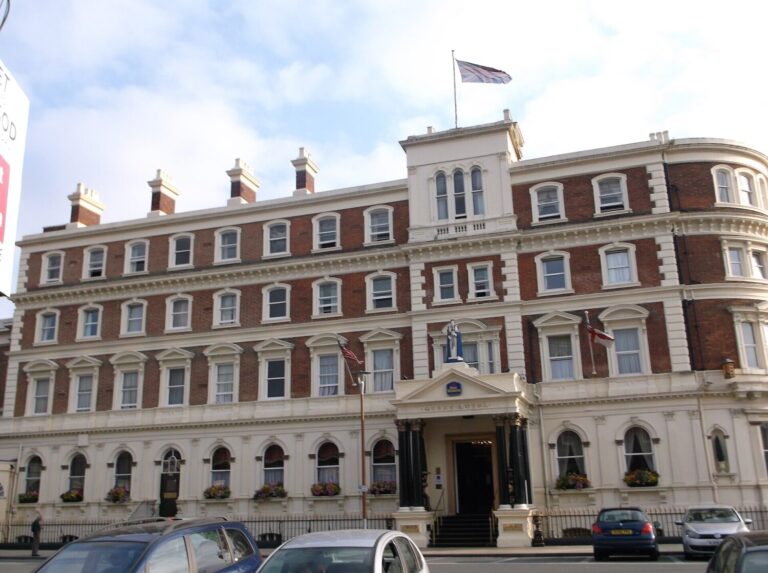 Photo: Harry Mitchell (CC BY 3.0) via Wikimedia Commons
By the station
Chester station sits about three quarters of a mile north-east of the walls, and City Road runs from the station down towards the canal and the centre. If you are arriving by train – forty minutes from Liverpool, a little over two hours from London Euston – staying at this end saves you dragging luggage across the city twice.
The Queen Hotel stands directly opposite the station entrance, a substantial Victorian railway hotel of the type most cities have lost, and there are chain hotels and guest houses along City Road and the surrounding streets. It is a fifteen to twenty minute walk into the centre, mostly downhill on the way in, and the canal towpath makes a more pleasant route than the road. Rates are usually noticeably lower than inside the walls for the same standard of room.
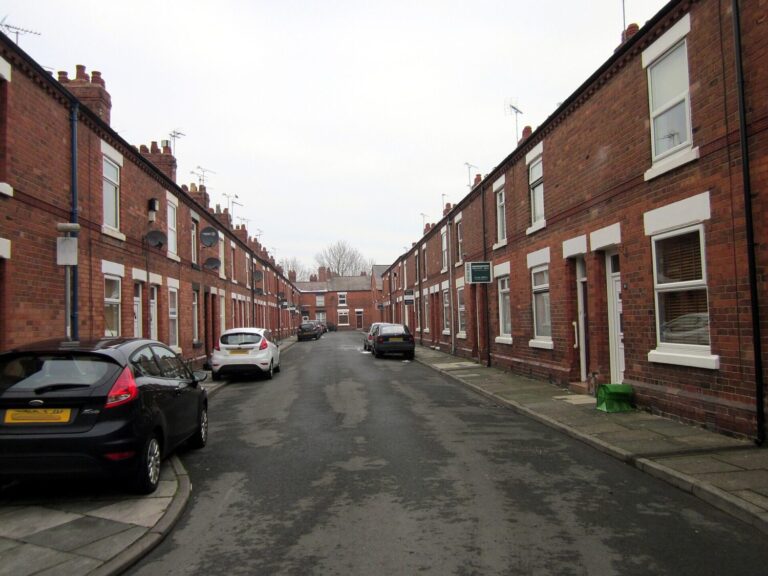 Photo: Jeff Buck (CC BY-SA 2.0) via Wikimedia Commons
Hoole
Hoole is the suburb just beyond the station, a grid of Victorian terraces that has quietly become the best-value place to stay in Chester and rather a good place to eat. Faulkner Street is the spine of it, lined with independent cafés, delis, a bookshop and a run of small restaurants that locals use far more than visitors do.
Accommodation here is mostly bed and breakfast and small guest houses in converted Victorian villas, family-run and considerably cheaper than the centre – often half the price on a race weekend, when the walled city prices itself out of reach. You are twenty to twenty-five minutes’ walk from the Cross, or a short bus ride, and about ten minutes from the station. If you want a proper breakfast, a quiet street and change from what a central hotel would cost, this is the answer.
Out into Cheshire
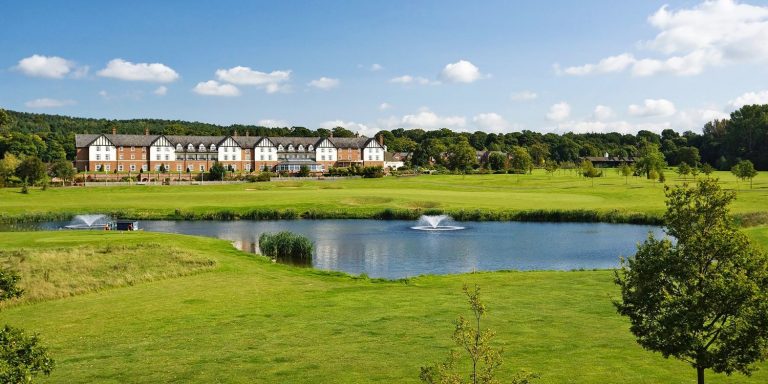
Chester sits in the middle of good country, and if you have a car the options widen considerably. Within twenty or thirty minutes you can reach country house hotels, golf and spa resorts, converted farm buildings and village inns with rooms – generally with more space, gardens, and parking you do not have to think about.
Carden Park, nine miles south, is the largest of them: a thousand acres with two golf courses, a spa and a vineyard. Elsewhere the villages east and south of the city – Christleton, Tattenhall, Tarporley – have inns and small hotels that make a comfortable base if you plan to combine Chester with North Wales, the Peak District or the Cheshire countryside. The obvious catch is that you will be driving to and from the city, and parking inside the walls is the same problem it always was; the park-and-ride sites on the approach roads are the sensible answer for a day in town.
Types of place to stay
What you will actually find when you start searching.
Grand and historic hotels
The Grosvenor on Eastgate Street is the landmark – black-and-white, five star, and owned by the Duke of Westminster’s estate. The Queen by the station is the other survivor of the great Victorian hotels. Expect city-centre prices and proper service.
Boutique and townhouse
Chester does this well. Georgian and Victorian townhouses converted into small hotels of eight or ten rooms, often with a good restaurant attached. Edgar House, built into the city wall above the river, is the best known.
B&Bs and guest houses
Concentrated in Hoole and along the approach roads, mostly family-run in Victorian villas. The best value in the city by a distance, and the breakfasts are usually a cut above what the chains manage.
Self-catering and apartments
Serviced apartments inside the walls suit longer stays and families; converted cottages and barns in the villages suit anyone with a car. Useful if you want to cook, or if you are staying a week rather than a weekend.
Budget and chain
The usual national chains have sites near the station, on the ring road and just outside the walls. Reliable, cheap midweek, and they fill up and spike in price on race weekends like everything else.
When to book, and what to watch for
Chester has a handful of dates each year when the whole city sells out. Knowing them saves both money and disappointment.
Race days
The May Festival and the other Roodee meetings fill every room in the city and push prices to two or three times the usual rate. Check the racing calendar before you fix dates – or book months ahead if a meeting is the reason you are coming.
The Christmas market
From mid-November to just before Christmas the market runs in front of the Town Hall and weekends get very busy. Midweek nights in that period are far easier and cheaper than Fridays and Saturdays.
Parking
Ask before booking whether there is on-site parking or a permit. Inside the walls there is very little on-street parking, and several nights in a multi-storey can add meaningfully to the cost of a trip.
Getting around without a car
If you are staying centrally you will not need one. The station is a twenty-minute walk or a short bus ride, and the park-and-ride sites on the approach roads are the easiest option for day visitors driving in.
Basing yourself on the coast instead
Chester fills up on race days and right through the Christmas market, and rates inside the walls move accordingly. If you are planning a longer trip and the city is turning out to be the expensive part of it, it is worth knowing that the North Wales coast is close enough to work the other way round: stay on the coast, and treat Chester as the day out. The A55 and the Holyhead main line both run west from the city, and an hour on either gets you to Llandudno Junction.
Llandudno has considerably more rooms than Chester and a much wider spread of price — a long seafront of Victorian hotels, with B&Bs and self-catering on the streets behind — which makes it a practical fallback on a weekend when Chester is booked solid or quoting silly money. The Llandudno accommodation guide is the place to compare what is there. Conwy, three miles round the estuary and walled like Chester, is the quieter option if you would rather not be in a resort at all — smaller, older, and a much shorter walk from castle to pub.
The trade-off is obvious enough: you get the coast and the mountains behind it, but you lose the evenings in Chester, which are a good part of the point of coming. For two nights, stay in the city. For a week, the coast is the better base.
Plan the rest of your trip
Once you have somewhere to stay, have a look at the twenty attractions worth your time, where to eat and drink, the history of the city, getting to Chester and day trips into North Wales and beyond.
Photographs are credited beneath each image. Images without a credit are from this site’s own collection. Sourced images are used under Creative Commons licences via Wikimedia Commons.
Hero photograph: Stephen Richards (CC BY-SA 2.0) via Wikimedia Commons