
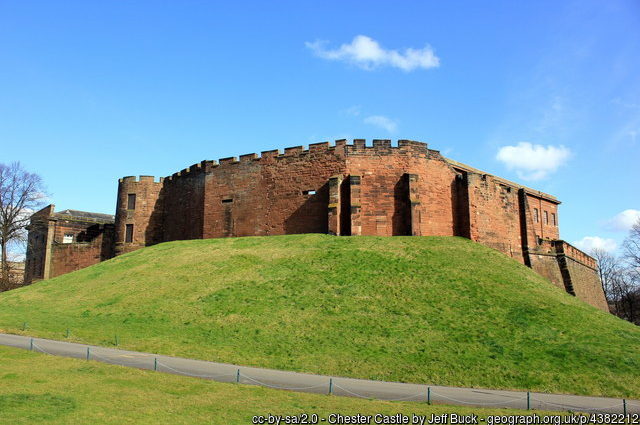


Chester Castle stands at the south-west corner of the walled city, on rising ground above the River Dee. Hugh d’Avranches, Earl of Chester, raised a motte-and-bailey here in 1070, probably over an earlier Saxon fortification, and through the medieval period it grew in stone as the administrative heart of the county palatine of Chester.
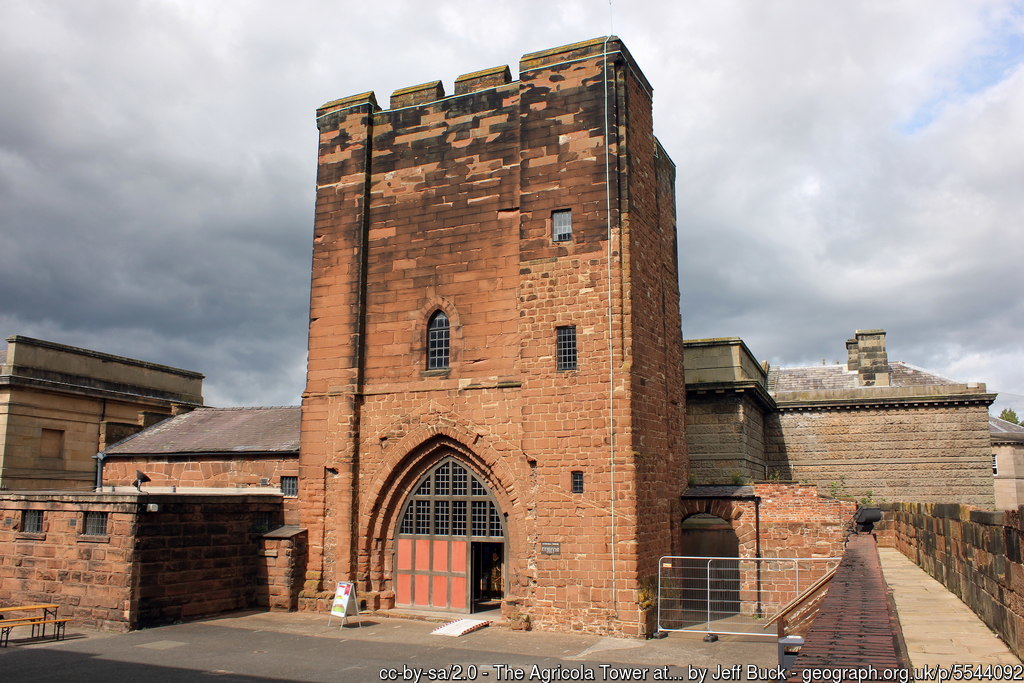
What survives from that era is chiefly the Agricola Tower, a 12th-century stone gateway that later became the entrance to the inner bailey. On its first floor is the chapel of St Mary de Castro, and conservation work in the 1990s uncovered a set of 13th-century wall paintings there showing the Visitation and miracles of the Virgin Mary – a rare survival of medieval English wall painting, and the reason the tower is a scheduled monument in its own right. The chapel now serves as the regimental chapel of the Cheshire Regiment.
The rest of what you see is a different building altogether. Between 1788 and 1822 the architect Thomas Harrison swept away most of the medieval outer bailey and replaced it with a courthouse, a prison, barracks and an armoury in the Greek Revival style. Nikolaus Pevsner rated the result one of the most powerful monuments of the Greek Revival in the whole of England. The propylaeum – the massive Doric entrance screen on Grosvenor Street, flanked by lodges built like miniature temples – is the part most visitors photograph, and it is Grade I listed.
The site is still working rather than preserved: the Crown Court sits in Harrison’s Shire Hall, and the Cheshire Military Museum occupies the former barracks. The inner bailey and the Agricola Tower are managed by Cheshire West and Chester Council on behalf of English Heritage. It is a five-minute walk from the Cross, and sits directly beside the Grosvenor Museum and the racecourse.
Official website: en.wikipedia.org/wiki/Chester_Castle