
Chester history · 1622 to now
The Grosvenors
The park, the bridge, the museum, the hotel, half the black-and-white city and a good deal of London — one family, four miles from Chester Cross.
Walk round Chester noting the name and you will not get far before you have to stop. Grosvenor Park, Grosvenor Bridge, Grosvenor Museum, Grosvenor Road, the Grosvenor Hotel, the Grosvenor Shopping Centre. It is not vanity signage. Most of those things exist because the family paid for them.
The Grosvenors have been at Eaton, four miles south of the city, since the early seventeenth century, and by the late nineteenth they were the richest family in Britain. Chester is what a small provincial city looks like when that happens next door to it.
The short version
The marriage that changed everything
Cheshire gentry until 1677. After that, something else entirely.
Richard Grosvenor was created Baronet of Eaton in January 1622, which put the family firmly among the Cheshire gentry and no higher. What transformed them was a marriage. In 1677 Sir Thomas Grosvenor married Mary Davies, then twelve years old, who was heir to five hundred acres of marshy ground west of the City of London.
That ground became Mayfair and Belgravia. Everything that follows in Chester — the park, the bridge, the museum, the rebuilding of half the city centre — was ultimately paid for by London rents.
The titles tracked the money. Baron Grosvenor in 1761, Earl Grosvenor in 1784, Marquess of Westminster at William IV’s coronation in 1831, and Duke of Westminster in 1874.
Eaton Hall
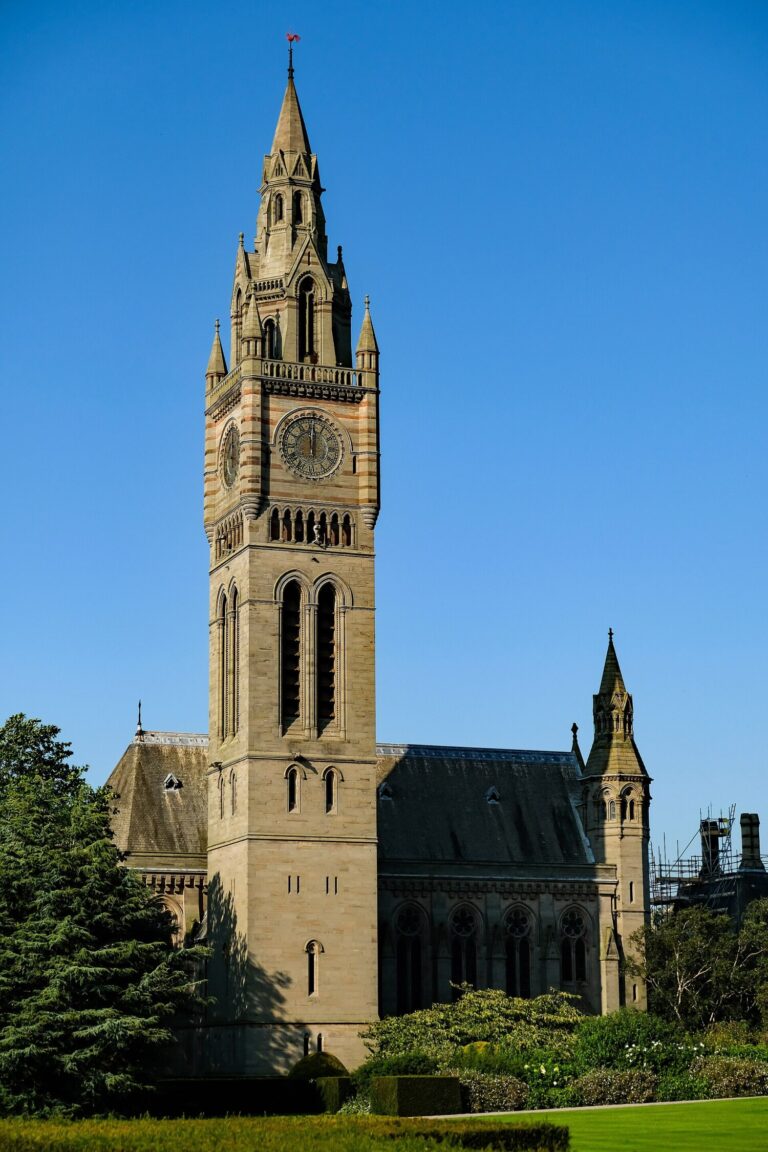 Photo: Jeff Buck (CC BY-SA 2.0), via Wikimedia Commons
1675 to the present, four times over
The first substantial house was built for Sir Thomas Grosvenor from 1675 by William Samwell, using stone carted from the ruins of Holt Castle across the Welsh border. William Porden encased it in Gothic between 1803 and about 1812 at a cost of over £100,000; Queen Victoria visited in 1832 and pronounced it magnificent. William Burn altered it again from 1845.
Then, in 1870, the 1st Duke commissioned Alfred Waterhouse — the architect of Manchester Town Hall and the Natural History Museum — to rebuild it properly. The work took twelve years and cost £803,000. Pevsner called the result the most ambitious instance of Gothic Revival domestic architecture anywhere in the country. It had a ninety-foot library, a dining room of a hundred and five feet, and an octagonal great hall with an organ.
Almost all of it is gone. Dry rot was found in the roof by 1960, and in 1963 the 4th Duke had the main house and the private wing demolished. Waterhouse’s chapel, clock tower and stable court survive and are Grade I listed. A new house by John Dennys went up from 1971 and was re-cased in French château style by the Percy Thomas Partnership between 1989 and 1991 — a sequence the Pevsner guide summarises, unkindly and accurately, as Château style, Eaton style, but also Tesco style.
What they gave Chester
 Photo: Łukasz Nurczyński (CC BY-SA 4.0) via Wikimedia Commons
A park, a bridge, a museum
Grosvenor Park was given by the 2nd Marquess, laid out by Edward Kemp in 1865–66 and opened in November 1867. Twenty acres on the river cliff, Grade II* registered, restored at a cost of £3.6 million in 2014. John Douglas designed the lodge.
The Grosvenor Bridge, Thomas Harrison’s single stone arch of 200 feet, had its first stone laid in 1827 and was opened in October 1832 by the young Princess Victoria. It was the longest single-span stone arch in the world for the next thirty years and is Grade I listed.
The Grosvenor Museum opened in 1886, funded by the 1st Duke and designed by Thomas Meakin Lockwood in red brick with Dutch gables. It holds the Roman collection, the city’s art, and a period house at 20 Castle Street. Admission is free. Between them these three are probably the best case in England for what a single landowning family could do to a city in one generation.
The architects on the payroll
The scale of the building programme is easy to underestimate. For the 1st Duke alone, John Douglas designed something in the order of four churches, eight large houses, fifteen schools, fifty farms, three hundred cottages and lodges, two factories, two inns and a dozen commercial buildings on the Eaton estate. Douglas produced around five hundred buildings across his career, and a very large share of them were Grosvenor commissions.
Thomas Meakin Lockwood worked for the Duke too, and gave Chester 1 Bridge Street in 1888 and 2–8 Bridge Street in 1894 as well as the museum. The result is the black-and-white revival that defines the modern city centre — a house style, applied at scale, with one client behind it.
More on the black-and-white revival
And the racing
The Grosvenors put up the Grosvenor Gold Cup at Chester Races in 1744 and have been part of the Roodee ever since. The May Festival, established in 1766, grew during the period when the family were the dominant social power in the county, and the connection between the estate, the city and the racecourse is one of the reasons Chester racing has the character it does.
The estate over the border
The Grosvenor story is usually told as a Cheshire one, but the estate never respected the border, and neither did the building materials. Samwell’s Eaton Hall of 1675 was raised partly with stone carted from Holt Castle, eight miles upriver on the Welsh bank of the Dee — a fortress of Edward I’s generation, dismantled after the Civil War and quarried by its neighbours. A good deal of the earliest Eaton Hall was, quite literally, a Welsh castle rearranged.
The comparison worth making is a few miles further on. Erddig, outside Wrexham, was begun in the 1680s — the same generation as the first Eaton Hall, on the same river system, for a Denbighshire man who went spectacularly bankrupt paying for it. Where the Grosvenors rebuilt Eaton four times over and demolished Waterhouse’s version in 1963, Erddig stayed put and ran out of money instead, which is why it survives with its furniture, its outbuildings and its servants’ quarters more or less intact. It is now the National Trust house that tells its story from below stairs rather than above.
Put side by side, the two estates make the point better than either does alone: on the English bank, a family whose London rents let them start again every fifty years; on the Welsh bank, one that could not, and preserved everything by accident.
Seeing it
Eaton Hall itself is a private house, but the gardens open to the public on three days a year for charity, and the Stable Court holds exhibitions including the Westminster carriage collection. Check the estate’s website for dates well in advance; they sell out.
In the city, everything is walkable. Start at the Grosvenor Museum on Grosvenor Street, walk down to the castle and out onto the Grosvenor Bridge, come back along the walls above the Roodee, then cross the centre to Grosvenor Park and St John’s. That circuit takes about two hours and covers most of what the family built.
See all 20 Chester attractions · The Roodee and Chester Races
Keep reading
More Chester history.
Georgian and Victorian Chester · The black-and-white revival · Chester Castle · All history
Photographs are reproduced under Creative Commons licences; the photographer and licence are credited beneath each image.
Hero photograph: Jeff Buck (CC BY-SA 2.0), via Wikimedia Commons