
Chester history · a play cycle that will not die
The Chester Mystery Plays
The longest-surviving medieval play cycle in England — banned in 1578, revived in 1951, and still performed by the people of the city every five years.
Four English towns kept a full cycle of biblical plays into the modern record: York, Wakefield, Coventry and Chester. Chester held out the longest against the authorities who wanted them stopped, and Chester is the one that brought them back.
They are not a heritage re-enactment. The cast is drawn from the city, the production is professionally directed, and the last full cycle filled the nave of the cathedral. The next is planned for 2028.
The short version
What a mystery play actually was
 Photo: Christopher Hilton (CC BY-SA 2.0) via Wikimedia Commons
Theatre made by tradesmen
A mystery cycle is the whole Bible in episodes, from the Creation to the Last Judgement, performed in sequence by the craft guilds of a city. Mystery here has nothing to do with the supernatural — it comes from the same root as the French metier, a trade. Each company took a pageant and paid for it: the costumes, the waggon, the players, the rehearsals.
The allocations were often pointed. In Chester the water-leaders and drawers of the Dee took Noah and the Flood, which is exactly the sort of joke a medieval city enjoyed. The waggons were pulled through the streets and each play was performed several times over at fixed stations — at the Cross, outside the abbey gate, at the High Cross and elsewhere — so a spectator could stand in one place and watch the whole of scripture go past.
The texts we have
A curious thing about the Chester cycle: the manuscripts are younger than the ban.
None of the surviving copies is a working script from the great years. They were made by antiquarians and civic-minded copyists after performance had stopped — one manuscript is signed off by George Bellin in 1592, another carries banns dated 4 June 1600, and the main texts date from between 1591 and 1607. Chester therefore preserved its plays in the way a city preserves a charter: deliberately, and slightly defiantly, once it could no longer perform them.
The principal manuscripts are now in the Bodleian (MS Bodley 175), the Huntington Library in California (MS 2) and the British Library (Harley MS 2124).
The long argument with London
 Photo: Michael D Beckwith (CC0) via Wikimedia Commons
1560s–1578
After the Reformation the plays became a political problem. To the Elizabethan church they were popery in the streets; to the corporation of Chester they were civic property, a source of pride and of trade, and nobody in London had any business interfering.
Chester put them on in 1562, in 1568 and again in 1572, each time against increasing pressure. There was a further staging in 1575, and one last cycle in 1578. Then they stopped. Every other English town had already given way; Chester was the last to concede, which is why the Chester cycle is described as the longest-surviving in the country.
1951, and what came back
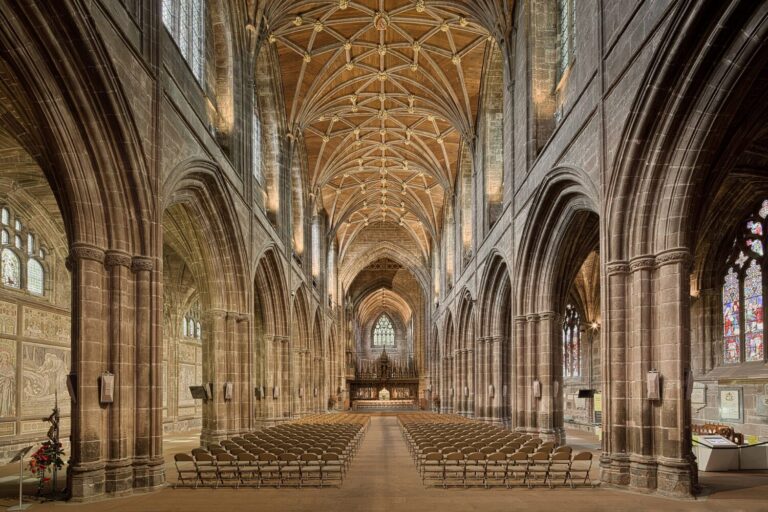 Photo: Michael D Beckwith (CC0), via Wikimedia Commons
The modern cycle
The plays returned in 1951 as part of the Festival of Britain, and have been staged in Chester roughly every five years since. That pattern has now held for three-quarters of a century, which is longer than the documented run of the medieval performances in their final, embattled phase.
The modern productions have moved around the city — the ruins beside St John the Baptist, the cathedral green, a purpose-built arena in the cathedral grounds. In 2023 the cycle was staged inside the nave of the cathedral itself, presented mainly by members of the local community under professional direction. The next full production is planned for 2028.
Why they matter
English drama did not begin with Shakespeare. It began in the streets of towns like this one, made by guilds of tanners and bakers and water-carriers, in front of audiences who knew the stories and came for the performances. The mystery cycles are the direct ancestor of the Elizabethan stage, and they are the only substantial body of English theatre that was written, funded, cast and performed by ordinary working people.
Chester keeping them going into the 1570s, and picking them up again in 1951, says something fairly precise about the place: a city that has always taken its own past more seriously than anybody told it to.
Seeing them
Between cycles there is nothing to watch, but there is something to look at. The stations where the waggons stopped were at the Cross and along the four main streets — stand at the Cross on a busy Saturday and the geography makes immediate sense. The guilds that funded the plays met in halls scattered around the centre, and several of their names survive on buildings.
The cathedral, which staged the 2023 cycle, has material on the plays and is free to enter. Tickets for a cycle year go on sale well in advance and sell out; if you are planning a visit around the 2028 production, book early.
Keep reading
More Chester history.
Medieval Chester · Chester Cathedral · Tudor and Stuart Chester · All history
Photographs are reproduced under Creative Commons licences or released to the public domain; the photographer and licence are credited beneath each image.
Hero photograph: Mike McBey (CC BY 2.0), via Wikimedia Commons