
Beyond the walls
Day Trips from Chester
Mountains one way, two great cities the other, and a coastline in between – all within about an hour.
Chester sits on the border, which makes it an unusually good base. Head west and you are in Wales within ten minutes and among mountains within the hour. Head north-east and you have Liverpool and Manchester, two of the most interesting cities in Britain, both reachable by train.
Everything below is a genuine day trip – out after breakfast, back for dinner – and most of it is possible without a car.
Eight days out
Roughly in order of distance, from the mountains to the county next door.
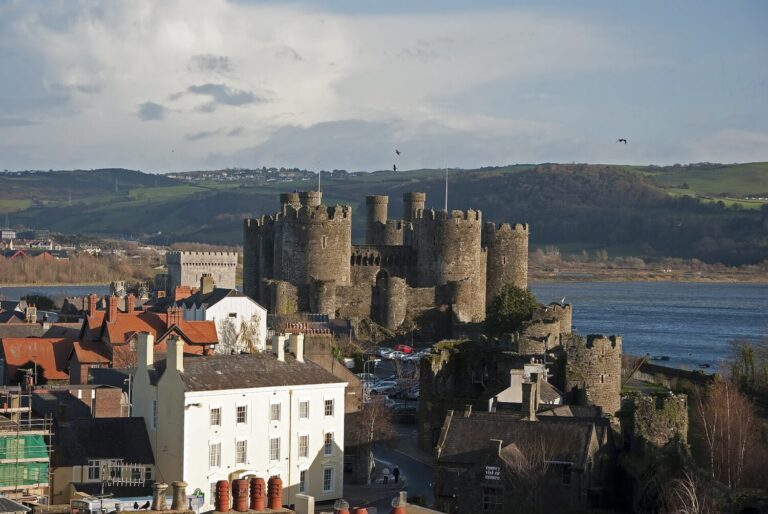 Photo: Chris Gorringe (CC BY-SA 2.0) via Wikimedia Commons
Conwy and the North Wales coast
The A55 runs west from Chester along the North Wales coast, and the railway follows it. Conwy is about an hour by either, and it is the obvious counterpart to Chester: another complete circuit of medieval town walls, this time wrapped around a castle Edward I built in the 1280s. Both castle and walls are a UNESCO World Heritage Site, and the walls here are walkable too.
A little further on, Llandudno is the great surviving Victorian seaside resort of North Wales – a sweeping bay, a pier, and the Great Orme rising behind it with a tramway and a cable car to the top. It makes an easy, unhurried day out and it is well set up for it.
Both towns repay a bit of planning rather than a wander. At Conwy the castle and the town walls are the point — one continuous circuit of 1.3km with twenty-one towers, put up between 1283 and 1287 and UNESCO-listed since 1986 — and the walk round Conwy’s town walls takes under an hour, with the best views of the estuary from the top corner. Llandudno is a different sort of day altogether: pier, promenade and the Great Orme behind it, with a tramway and a cable car to the summit, and there is a full rundown of things to do in Llandudno if you want to fit more than a walk along the front into it.
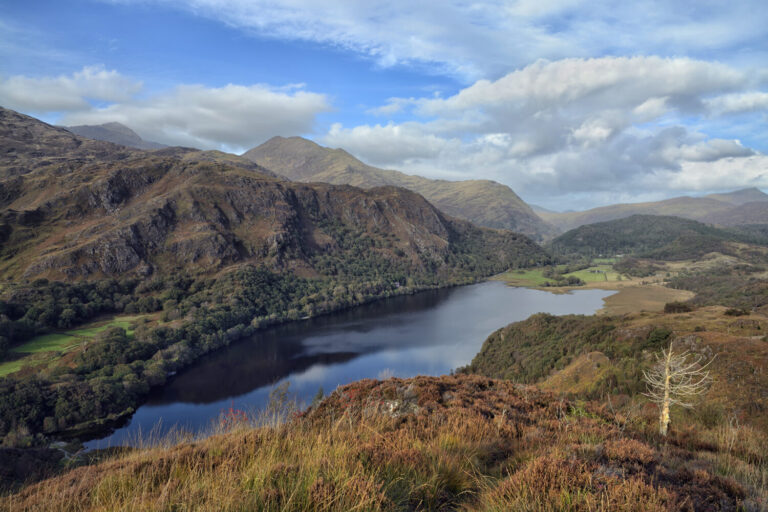 Photo: Petersrockypics (CC BY-SA 2.0) via Wikimedia Commons
Eryri (Snowdonia)
The national park begins roughly ninety minutes from Chester by car, and it changes the day entirely – from a walled city to genuine mountain country. Yr Wyddfa (Snowdon) is the obvious target, either on foot by one of six paths or on the Snowdon Mountain Railway from Llanberis, but it is busy and the walking is serious.
For a first visit with less commitment, Betws-y-Coed is the usual base: a village in the Gwydir Forest with waterfalls, walks of every length and a good number of places to eat, about an hour and a quarter away. The Swallow Falls are a short drive up the valley. The walking routes around Betws-y-Coed are graded from flat riverside loops to full mountain days, which makes it easy to match the walk to the weather and to whoever you have brought with you.
Take the weather seriously if you are going up anything. Conditions on the tops are nothing like conditions in the car park, and mountain forecasts are worth checking the morning you go.
 Photo: Stephen Halpin (CC BY-SA 2.0) via Wikimedia Commons
Liverpool
Forty minutes by train and genuinely easy – frequent Merseyrail services from Chester run direct to Liverpool Central, and you step out in the middle of the city. This is the single best day trip from Chester if you want a city rather than a landscape.
The waterfront is the thing: the Three Graces at the Pier Head, the Albert Dock with Tate Liverpool and the Maritime Museum, and the ferry across the Mersey. Add the two cathedrals at opposite ends of Hope Street, the Walker Art Gallery, and the Beatles material at the Cavern Quarter and the Beatles Story if that is your interest.
More at visitliverpool.com.
 Photo: Anthony O’Neil (CC BY-SA 2.0) via Wikimedia Commons
Manchester
About an hour by train and a very different proposition from Liverpool – less waterfront and grand civic set-piece, more music, food, independent shops and industrial history reworked into something else.
The Science and Industry Museum sits in the world’s oldest surviving passenger railway station. Manchester Art Gallery and the Whitworth are both strong. The Northern Quarter is the place to wander, eat and browse record shops; Ancoats next door has become one of the better places to eat in the north of England.
It is also the easier of the two for shopping, if that is the point of the day.
 Photo: Jeff Buck (CC BY-SA 2.0) via Wikimedia Commons
Wrexham
Wrexham is the closest of these by a distance — twelve miles, about half an hour on a direct train — and for years almost nobody treated it as a day out. That has changed. The Racecourse Ground holds the Guinness record as the oldest international football ground still in use, having hosted Wales against Scotland on 5 March 1877 and internationals ever since, and the club’s Hollywood ownership has put the town on a lot of itineraries that would have skipped it a decade ago.
There is a good deal more than football. St Giles’ Church has one of the Seven Wonders of Wales in its tower, and Elihu Yale — the merchant whose bequest named Yale University — is buried in the churchyard. Erddig, the National Trust house on the edge of town, is unusual for telling its story from the servants’ hall rather than the drawing room.
Further out is the industrial landscape that once fed Chester’s port: Bersham Ironworks, where John Wilkinson cast cylinders for the first Boulton and Watt engines, and the Minera lead mines, whose output went down the Dee through Chester until the river silted.
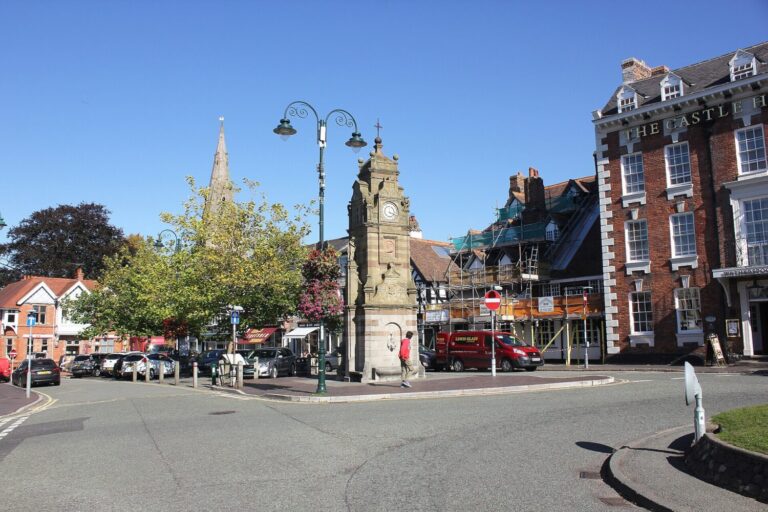 Photo: Jeff Buck (CC BY-SA 2.0) via Wikimedia Commons
Ruthin
Ruthin is the other near option — twenty-five miles, three quarters of an hour by car, and no railway, which is probably why it stays so quiet. It is a medieval planted town of the same generation as Conwy, laid out around a square on a low hill in the Vale of Clwyd, with a castle at one end that is now a hotel.
What makes it worth the drive from Chester is the timber framing. St Peter’s Square has the genuine article — Nantclwyd y Dre is among the oldest surviving timber-framed townhouses in Wales — and none of it was recut by a Victorian duke, which makes it the sharpest available contrast with Chester’s black-and-white revival. The old courthouse, the almshouses and St Peter’s collegiate church are all on the same square.
There is a Chester connection in the history too. Owain Glyndŵr’s revolt opened here on 18 September 1400 with an attack on the town, and Chester spent the following decade as the English supply base against it — the same border relationship as the Edwardian castles, a century on. Ruthin Castle is the surviving piece of that.
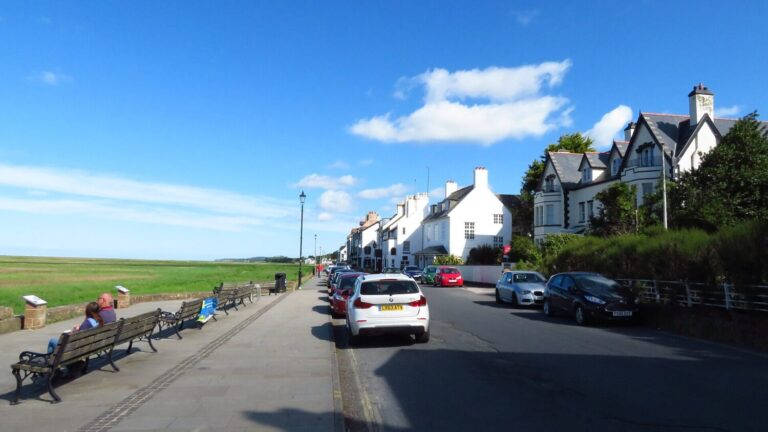 Photo: Colin Park (CC BY-SA 2.0) via Wikimedia Commons
The Wirral and the Dee estuary
The closest trip of all, and the most overlooked. Parkgate is twenty minutes from Chester: a Georgian sea front where the sea no longer reaches, because the Dee silted up here just as it did at Chester. The result is a promenade facing a vast saltmarsh instead of water, which is strange and rather beautiful, and one of the best birdwatching sites in the north-west – particularly on a high spring tide, when the marsh floods and everything living in it comes out at once.
The Wirral Country Park and the twelve-mile Wirral Way follow an old railway line down the peninsula from West Kirby to Hooton, good for walking or cycling. At the far end, the ferry and the beaches at West Kirby and Hoylake face out to the Irish Sea.
Parkgate is also known, locally and justifiably, for its ice cream.
 Photo: David Crocker (CC BY-SA 2.0) via Wikimedia Commons
Cheshire countryside
You do not have to leave the county. Delamere Forest, about twenty-five minutes east, is the largest area of woodland in Cheshire, with waymarked walking and cycling trails, a lake, and a station on the Chester–Manchester line so you can get there by train.
South of that, the Sandstone Trail runs thirty-four miles along the Cheshire ridge from Frodsham to Whitchurch, and individual sections make excellent half-day walks – the stretch past Beeston Castle, set on a crag with a view said to take in eight counties, is the one to pick if you only do one.
Further out, Tatton Park near Knutsford is a full country estate with a mansion, gardens and deer park, about fifty minutes away.
Planning
Getting around is covered on getting to Chester, which has the train and road connections in detail. If you are staying on, see the attractions, where to stay and where to eat and drink.
Wrexham and Ruthin are the two nearest of these and the two most often skipped, and either works if you only have half a day free. Both towns have their own guides that go further than there is room for here: things to do in Ruthin, and where to stay around Wrexham if the day turns into a night. Journey times are typical door-to-door estimates by car or direct train and will vary. Photographs credited beneath each image; sourced images used under Creative Commons licences via Wikimedia Commons.
Hero photograph: Petersrockypics (CC BY-SA 2.0) via Wikimedia Commons