Chester feeds a lot of people for a city of its size – the Rows alone carry two storeys of restaurants and bars, and the market hall added a dozen more kitchens in 2022. Rather than list individual restaurants, which change hands and close, this page covers the areas and what each is good for, so you can walk into the right part of town and choose when you get there.
The one genuinely durable recommendation is the pubs. Four of Chester’s are housed in buildings of real architectural importance, two of them Grade I listed, and they have been serving drinks for centuries. They are covered further down.
Where to eat, by area
Four parts of the city, each with a different character and price level.
 Photo: Christopher Hilton (CC BY-SA 2.0) via Wikimedia Commons
The Rows and the city centre
The four streets running out from Chester Cross carry most of the city’s eating and drinking, and the Rows give it a shape you will not find elsewhere: restaurants and bars at street level, and another tier of them up on the galleried walkway above, reached by steps. It is worth walking both levels before deciding, because the upstairs places are easy to miss entirely from the pavement.
Watergate Street and Northgate Street have the densest run of independents, and the side lanes off Bridge Street hide small places that seat twenty people. Godstall Lane and St Werburgh Street, tucked behind the Cathedral, are pedestrianised and fill with tables in summer. The centre covers the full range – long-established restaurants with white tablecloths, small-plate and tapas places, brunch cafés, and the national chains clustered around the bigger junctions. Weekend evenings are busy and the better independents are genuinely hard to get into without booking.
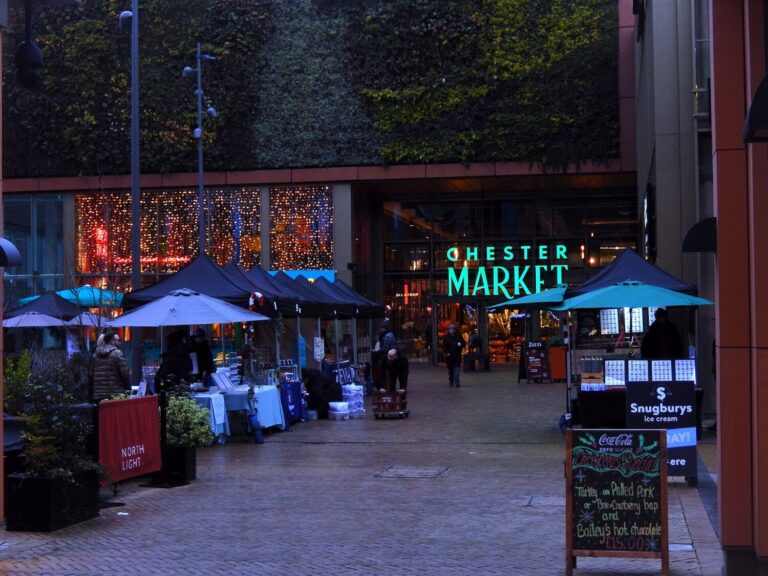 Photo: Stephen McKay (CC BY-SA 2.0) via Wikimedia Commons
Chester Market and Exchange Square
The single most useful place to eat in the city, particularly with a group who cannot agree. The market moved into its purpose-built hall in Exchange Square in November 2022, and about a third of it is a communal food hall – a dozen or so independent kitchens around a central bar, with shared oak tables between them.
Everyone orders what they want from whichever counter they like and eats together, which solves most family arguments. The rest of the hall is a working market: greengrocers, a butcher, a fishmonger, cheese, bread and a scattering of makers. It runs six days a week, closed Mondays, and stays open until 10pm from Tuesday to Saturday, which makes it a rare thing in Chester – somewhere you can eat well, cheaply and late without booking. Exchange Square outside is new public space and gets tables out whenever the weather allows.
 Photo: Colin Park (CC BY-SA 2.0) via Wikimedia Commons
The Groves and the riverside
The promenade along the Dee below the walls is where Chester eats outdoors. There are cafés and bars strung along the Groves with terraces facing the water, ice cream at the bandstand end, and boat trips leaving from the moorings in between.
It is more casual than the centre – pub food, pizza, coffee and cake rather than tasting menus – and on a warm afternoon it is the most pleasant place in the city to sit with a drink. The riverside works particularly well at the end of a walk: come down through the Roman Gardens from the amphitheatre, eat by the water, then cross the Queen’s Park suspension bridge and walk back along the far bank. Bear in mind that much of it is seasonal, and a wet Tuesday in February is a very different experience from a Saturday in July.
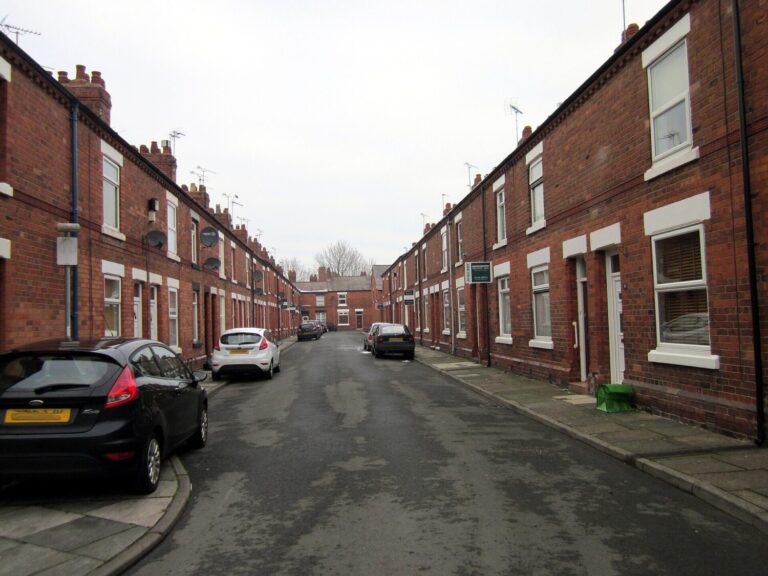 Photo: Jeff Buck (CC BY-SA 2.0) via Wikimedia Commons
Hoole
Ask people who live in Chester where they eat and a good number will say Hoole. The suburb beyond the station has turned Faulkner Street and the roads around it into a genuine independent quarter – delis, a bakery, coffee roasters, a bookshop with a café, and a run of small restaurants covering most cuisines.
It is cheaper than the centre, the places are mostly owner-run, and you will be sitting among locals rather than visitors. Portions and prices both tend to be more generous. It is twenty to twenty-five minutes’ walk from the Cross or ten minutes from the station, and worth the trip if you are staying more than a night or two and want to eat somewhere that is not aimed at tourists. Booking is still sensible at weekends – the good places are small.
Four historic pubs
Chester has an unusual number of pubs in genuinely important buildings. These four are worth going out of your way for, whether or not you drink.
 Photo: Stepped (CC BY-SA 3.0) via Wikimedia Commons
The Bear and Billet
Built in 1664 for the Earls of Shrewsbury, who controlled the Bridgegate a few yards down the street, and reckoned to be the finest 17th-century timber-framed town house in Chester. Three storeys and an attic, each one jettied out over the floor below, with banks of leaded windows and herringbone framing in the gable.
It was a town house and probably a grain warehouse before it became an inn in the 18th century, and it stayed in Shrewsbury hands until 1867. It is Grade I listed. Inside it is a proper pub rather than a museum piece – low beams, a decent range of cask ales and a courtyard at the back.
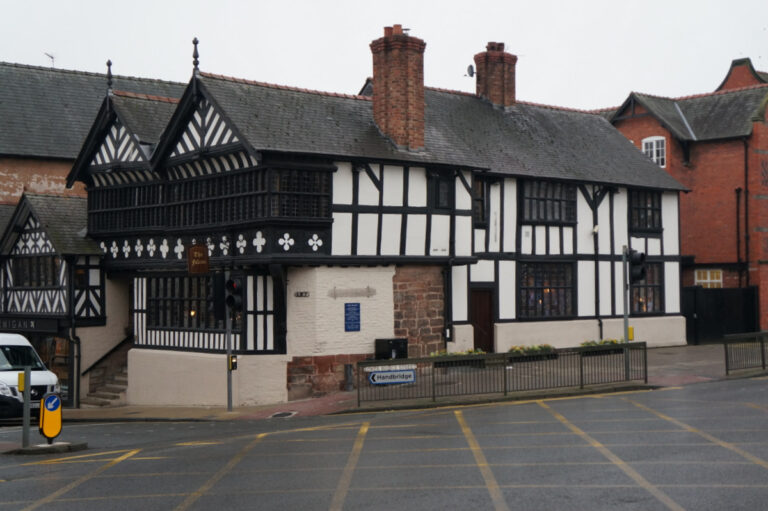 Photo: Ian S (CC BY-SA 2.0) via Wikimedia Commons
The Falcon
A house stood here by about 1200. Sir Richard Grosvenor bought it in 1602 and rebuilt it forty years later as his town house, moving the family in from Eaton Hall during the Civil War. In 1643 he petitioned successfully to enclose the stretch of the Rows running through the building – you are drinking inside what was once a public walkway, and his precedent was followed by neighbours all the way down Lower Bridge Street.
By the 1970s it was derelict. The Grosvenor Estate gave it to the Falcon Trust in 1979, restoration ran to 1982 and won a Europa Nostra award, and it reopened as a pub in 1992 with the Duke of Westminster doing the honours. Grade I listed, and the best place in the city to understand what the Rows actually were.
 Photo: Jeff Buck (CC BY-SA 2.0) via Wikimedia Commons
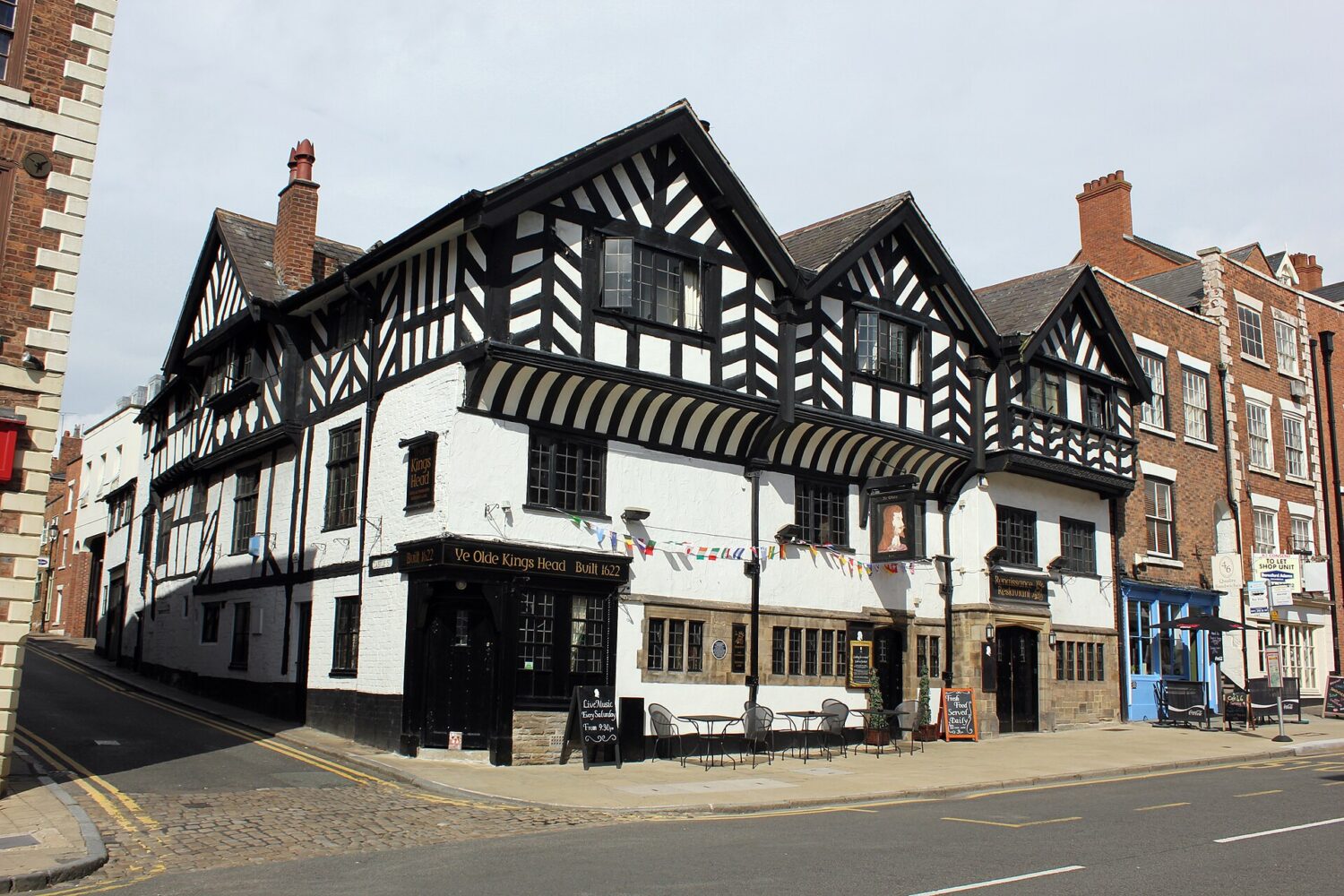
Ye Olde King’s Head
Another Lower Bridge Street survivor, and older than it looks. The listing records origins around 1208, with the cellars still holding early 13th-century stone walls, and the timber front you see is the result of rebuilding and refronting between the 15th and 17th centuries. It was renovated again in 1935.
Three storeys of decorated timber framing with herringbone panels, Tudor-arched doors and mullioned leaded casements – the full Chester vocabulary. It is Grade II* listed and runs as a pub with rooms above. It has a reputation as one of the more haunted buildings in a city that claims a great many of them, which the staff will happily tell you about.
 Photo: Rept0n1x (CC BY-SA 3.0) via Wikimedia Commons
The Albion Inn
Tucked against the city wall on Park Street, a short walk from the Newgate and the amphitheatre, the Albion is a Victorian corner pub that has committed entirely to the First World War. The interior is filled with period memorabilia – recruitment posters, trench maps, framed photographs, enamel signs – assembled over decades rather than bought in as a theme.
It is deliberately old-fashioned in the way it operates: no music, no machines, and a long-standing dislike of large groups and small children, which the landlord posts on the door without much diplomacy. Taken on its own terms it is one of the most characterful pubs in the north-west, serving proper cask beer and substantial British food.
Practical notes
A few things worth knowing before you set out.
Book at weekends
The good independents are small and Chester draws a lot of weekend visitors. Friday and Saturday evenings in the centre need booking, often several days ahead. Midweek you can usually walk in.
Race days
On Roodee meeting days the centre fills from lunchtime and stays full. Restaurants take bookings months out and many switch to set menus. If you are not going racing, eat in Hoole or at the market instead.
Look up
A good half of the places to eat in the centre are on the Rows walkway rather than at street level, and they are close to invisible from the pavement. Walk the upper tier along Watergate and Eastgate Street before you decide.
Late food
Chester is not a late-night city. The market hall serving until 10pm from Tuesday to Saturday is one of the more reliable options if you are eating after a show at Storyhouse.
Plan the rest of your trip
See also the twenty attractions worth your time, where to stay, the history of the city, getting to Chester and day trips into North Wales and beyond.
Photographs are credited beneath each image. Sourced images are used under Creative Commons licences via Wikimedia Commons. Opening times and trading details change – check directly before making a special trip.